
Underwater Ship Hull Cleaning: Techniques, ROVs, & Cavitation Technology
The hull of a ship gives it its shape and buoyancy and protects the parts and components inside. A ship’s main propulsion engine, generators, boilers, fuel pumps, air compressors, and other such equipment are all located within the hull of a ship.
Additionally, the crew and passenger quarters, as well as the cargo carried by the ship, are distributed between its hull and deck. The ship’s stability in water, speed, load-bearing capacity, efficiency, and safety are affected to a great degree by the structure of its hull.
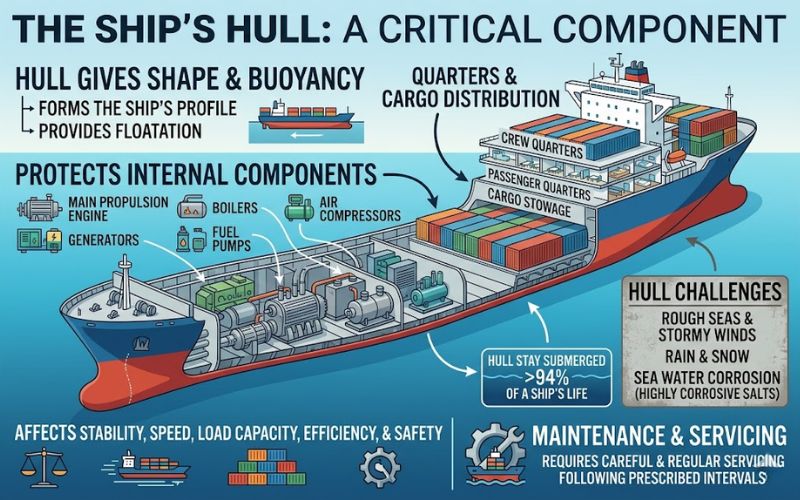
A ship hull has to resist rough seas, stormy winds, rain, and snow. Sea water can be highly corrosive because of the various salts it contains. Because the ship’s hull stays submerged most of the time, it is subject to higher levels of corrosion than other parts of the ship.
An estimated 94% of a ship’s life is spent on water. During a ship’s life, as with most of the ship’s infrastructure, its hull has to be maintained and serviced carefully following prescribed intervals.
Types of Hulls
A ship’s hull is constructed very carefully. The structure and design of the hull are quite complex and critical for the ship’s overall performance and safety on the seas.
Hulls of different types of ships vary. Naval architects consider various factors when they engineer a ship’s hull.
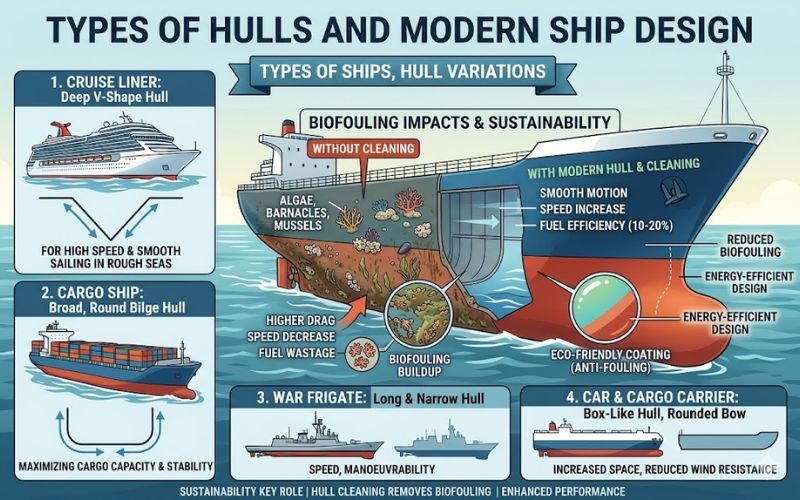
For example, the hull of a cruise liner varies from that of a cargo ship in shape and various other features. Most cruise liners have deep V-shaped hulls, while those of cargo carriers are broad, smooth, and continuous [round bilge hulls].
The hulls of war frigates are generally long and narrow for cutting through water at high speeds, stability, and manoeuvrability, while those of commercial car carriers and cargo carriers are box-like with rounded bows to increase the space inside while reducing wind resistance.
Modern ship hulls are designed and made with sustainability playing a key role alongside design and structure. Modern hull designs are energy-efficient and eco-friendly, e.g., coatings and paints used to reduce biofouling.
Biofouling is when organisms and other deposits form on the hull surface. Besides being corrosive, this acts as a drag on the ship’s motion.
Maintenance and service are critical for the efficient and smooth sailing of a ship. Cleaning the ship’s hull removes algae, barnacles, mussels, marine worms, and other deposits [biofouling] that increase the ship’s weight.
Accumulation of these deposits causes drag to the ship’s motion and thereby fuel wastage. A clean hull enhances the speed of a ship and therefore fuel efficiency by almost 10-20%.
Cleaning a Ship’s Hull
Hull cleaning is a complicated and time-consuming process. Ships are usually mandated to be drydocked for maintenance, servicing, and hull cleaning at least twice in 5 years. While dry-docked, the hull of a ship is cleaned and antifouling paint applied.
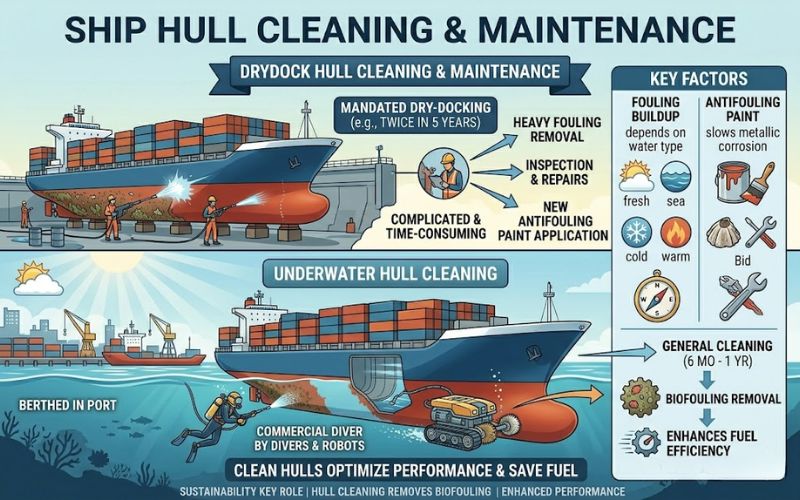
But hull cleaning is also done underwater when the ship is berthed in port or a service area. Generally, hull cleaning of ships is carried out once every 6 months to 1 year. When a ship is berthed, it is cleaned by divers with specialised equipment or underwater robots. The buildup on hulls depends to a large extent on the type of water the ship sails in. The coating of antifouling paint slows down the metallic corrosion of ship hulls.
Remotely Operated Vehicles [ROV] or Robots
Remotely Operated Vehicles [ROV] or Robots use high-pressure water jets, hydraulic or pneumatic brushes to remove the fouling from a ship’s hull.
Some of the robots use high-powered magnets that help them stick to the ship’s surface for cleaning. However, this method is only suitable for vessels that have a metallic hull on which magnets can attach themselves.
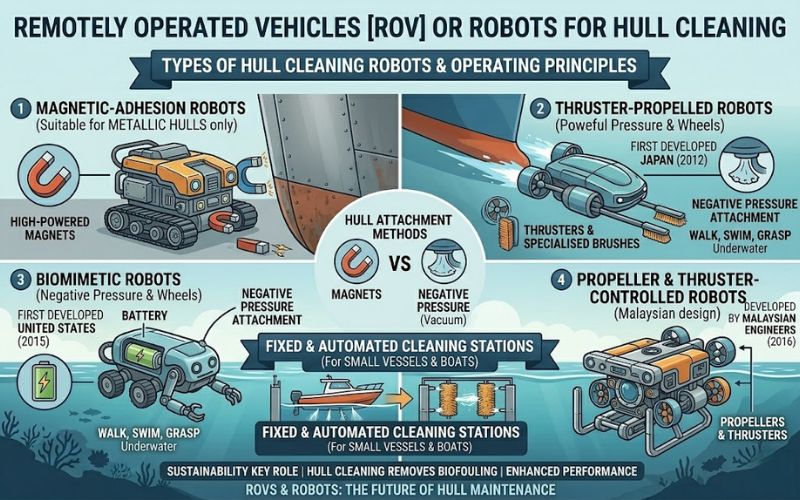
Another type of hull cleaning robot uses thrusters to move alongside and fix itself to the ship’s hull while cleaning. Hull cleaning robots that use thrusters for their movements and specialised brushes to clean the hull surface were first developed in Japan in 2012.
Others use biomimetic features [ability to walk, swim, or grasp while underwater] to move along the ship’s hull and clean up fouling agents from its surface.
Usually battery-powered, such robots use negative pressure to attach themselves onto the hull surface, and wheels help them move about. Robots that use biomimetic features were developed in the United States in 2015.
Another type of robot developed by Malaysian engineers in 2016 uses propellers and thrusters to control its movements as they go about cleaning the ship’s hull.
Smaller vessels and boats often make use of fixed and automated cleaning stations.
Cavitation Method
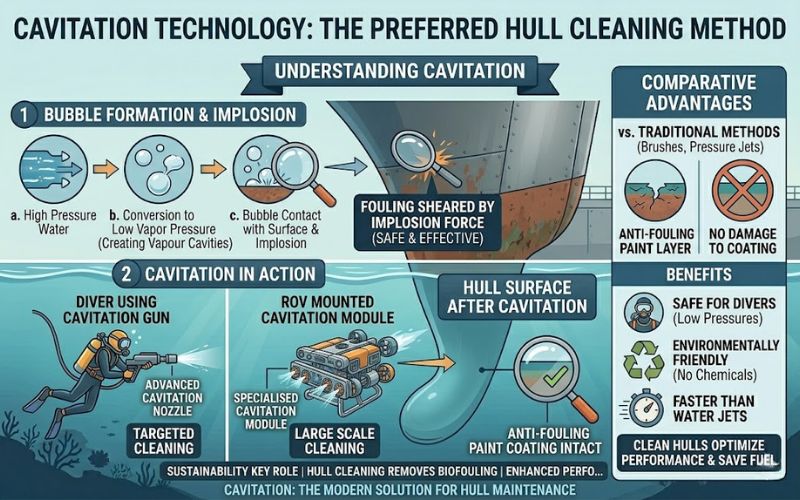
A preferred method of cleaning ship hulls these days uses modern cavitation technology. Besides being a safe technology for use by divers, it is also environmentally friendly, as there is no use of chemicals in this technique.
In cavitation cleaning, the fouling on the surface is sheared or scraped away by the implosion force of water bubbles. Unlike brushes or high-pressure water jets, cavitation cleaning does not damage the coating of anti-fouling paint on the ship’s hull. Compared to the traditional cleaning methods, it is also much safer to use underwater as the operating pressures are low.
How does the Cavitation Technique Work?
Cavitation is a phenomenon in fluid dynamics or hydrodynamics. In this method, seawater at high pressure is converted to its low vapour pressure, which creates tiny vapour bubbles or cavities. As these bubbles make contact with a surface, they implode or collapse, generating intense energy that effectively removes any biofouling without damaging the hull coating of the ship.
Advanced cavitation nozzles are used for this purpose. Cavitation guns are used by divers for targeted cleaning of the ship’s hull. Specially designed cavitation modules mounted on ROVs are also used for this purpose. The cavitation method of cleaning a ship’s hull is much faster than using traditional pressure water jets.
Environmental Concerns and Port Regulations
Cleaning a ship’s hull can release several things into its surrounding waters. These include living organisms such as barnacles, molluscs, algae, etc. Some of these could be invasive species.
Besides such organisms, cleaning also results in the release of heavy metals such as copper, zinc, etc., from anti-fouling paint. These are highly toxic and polluting to the marine ecosystem. Other debris that is discharged into the water as a result of hull cleaning can also affect the quality of the surrounding water.
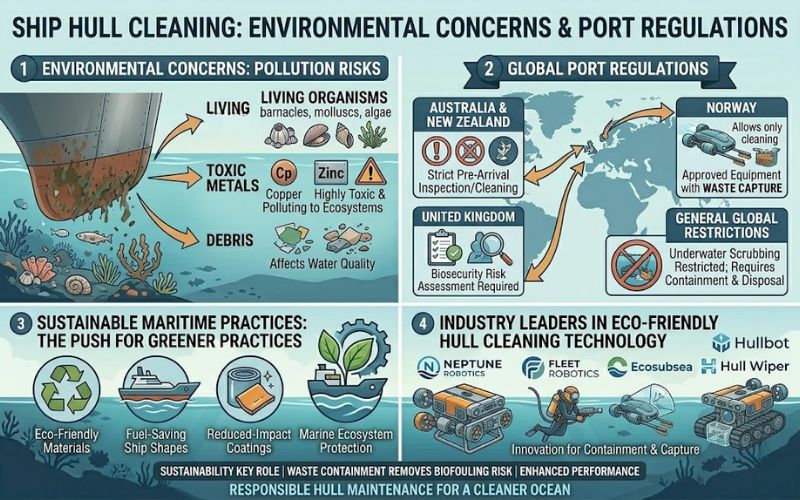
Port authorities of several countries have regulations in place to prevent the contamination of their sea waters and marine ecosystems as a result of hull cleaning, though they vary from country to country.
Countries such as Australia and New Zealand require that ships undergo strict pre-arrival inspection or cleaning. Some ports in the United Kingdom require ships to go through a biosecurity risk assessment before they are given permission for hull cleaning. Norway allows hull cleaning of ships only if they use approved, specialised equipment that captures waste and other debris that is discharged as a result of the cleaning.
In general, underwater scrubbing of hulls is restricted by most countries. Others require cleaning systems that can contain the discharge and capture it for proper disposal.
Sustainability is now a main concern, and the maritime industry goes for eco-friendly materials for their ships, fuel-saving shapes for the ship’s hulls, coatings that reduce environmental impact, and regulations to protect the marine ecosystem. The push for greener practices continues.
Neptune Robotics, Fleet Robotics, Ecosubsea, Hullbot, Hull Wiper, etc., are some of the leaders in hull cleaning technology.
You might also like to read-
- Different Parts Of A Ship’s Hull
- Why Do Ship’s Hull Fail At Midship Region?
- What are Wave-Piercing Hulls?
- Understanding Vessel’s Hull Speed And Its Determination
- What are Triple Hull Vessels?
Disclaimer :
The information on this website is for general purposes only. While efforts are made to ensure accuracy, we make no warranties of any kind regarding completeness, reliability, or suitability. Any reliance you place on such information is at your own risk. We are not liable for any loss or damage arising from the use of this website.


About Author
Hari Menon is a Freelance writer with close to 20 years of professional experience in Logistics, Warehousing, Supply chain, and Contracts administration. An avid fitness freak, and bibliophile, he loves travelling too.
Disclaimer :
The information on this website is for general purposes only. While efforts are made to ensure accuracy, we make no warranties of any kind regarding completeness, reliability, or suitability. Any reliance you place on such information is at your own risk. We are not liable for any loss or damage arising from the use of this website.


BE THE FIRST TO COMMENT