
U.S. Navy Sends First Crewless Ship Of Its Type To Sail With The USS Theodore Roosevelt
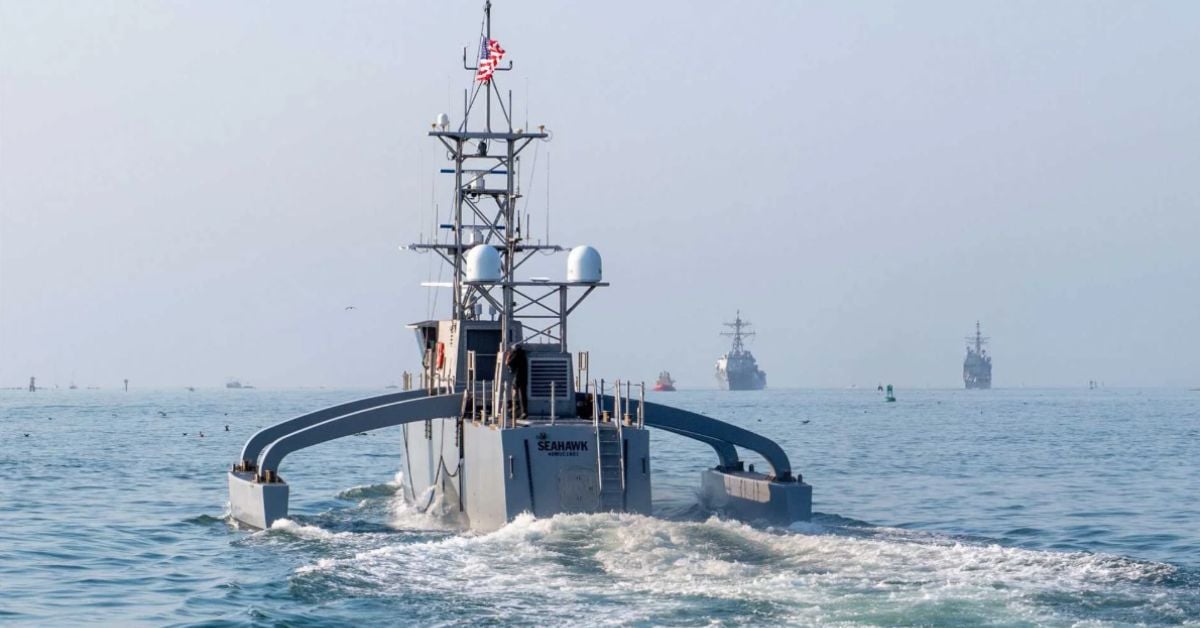
For the first time in U.S. naval history, an unmanned surface vessel has been deployed with a carrier strike group in a sustained deployment.
The vessel is the Seahawk, which is sailing alongside the U.S. Navy’s aircraft carrier Theodore Roosevelt across the Pacific Ocean as part of Carrier Strike Group 9.
Apart from the Nimitz-class carrier, other ships in the formation include the cruiser USS Chosin of the Ticonderoga-class, destroyers USS Paul Hamilton, USS Carl M. Levin, and USS Decatur.
There is also Air Carrier Wing 11, which includes F-35C Lightning II fighters, EA-18G Growler electronic-attack aircraft, Super Hornets, and E-2D Hawkeye airborne aircraft.
The entry of an unmanned vessel into the carrier strike formation that undertakes combat missions is of great importance for the Navy. This would give the service an opportunity to gather data regarding the integration of Seahawk’s autonomous systems, its command and control systems, and other features with the other vessels of the group.
While Seahawk does not provide extra ammunition, it acts as an autonomous surface component to this formation, coordinating with it throughout the operation by seamlessly interpreting and predicting the changing operational requirements without having a crew onboard.
The Medium Unmanned Surface Vessel Seahawk utilises Leidos Autonomous Vessel Architecture (LAVA) for navigation, avoiding obstacles and completing designated missions.
The aim of deploying Seahawk with the carrier group is to test the reliability and efficiency of an autonomous vessel in real-world conditions, moving further from controlled tests and trials.
The navy wants to check its interaction with other vessels, including escorts, replenishment ships and destroyers, over the long deployment.
This experiment could generate valuable data for the navy and also present areas of improvement, something which trials conducted in controlled environments cannot offer.
Autonomous decision-making capabilities, maintenance needs, endurance, etc can only be checked and ascertained in this manner, before the Navy can confidently decide to integrate more autonomous ships in its naval formations.
This would also help identify how unmanned autonomous vessels can complement the crewed vessels, without actually duplicating their roles or capabilities.
The focus is on adding to the already-existing capabilities without recruiting more naval personnel. Vessels like Seahawk are expected to widen the carrier group’s sensing, monitoring, and surveillance capabilities. They will also carry additional payload, sensor systems, weapons, and help in electronic warfare.
RELATED POSTS


Disclaimer :
The information on this website is for general purposes only. While efforts are made to ensure accuracy, we make no warranties of any kind regarding completeness, reliability, or suitability. Any reliance you place on such information is at your own risk. We are not liable for any loss or damage arising from the use of this website.

About Author
Zahra is a maritime writer with 6 years of technical writing experience spanning port operations, offshore wind, oil and gas, and maritime policy. Her analytical edge...Read More ->
Disclaimer :
The information on this website is for general purposes only. While efforts are made to ensure accuracy, we make no warranties of any kind regarding completeness, reliability, or suitability. Any reliance you place on such information is at your own risk. We are not liable for any loss or damage arising from the use of this website.
Related Articles
Subscribe To Our Daily Newsletter
By subscribing, you agree to our Privacy Policy you can unsubscribe anytime.


BE THE FIRST TO COMMENT