Historic Dredge McFarland Ends Operational Service After Nearly 60 Years Of Service
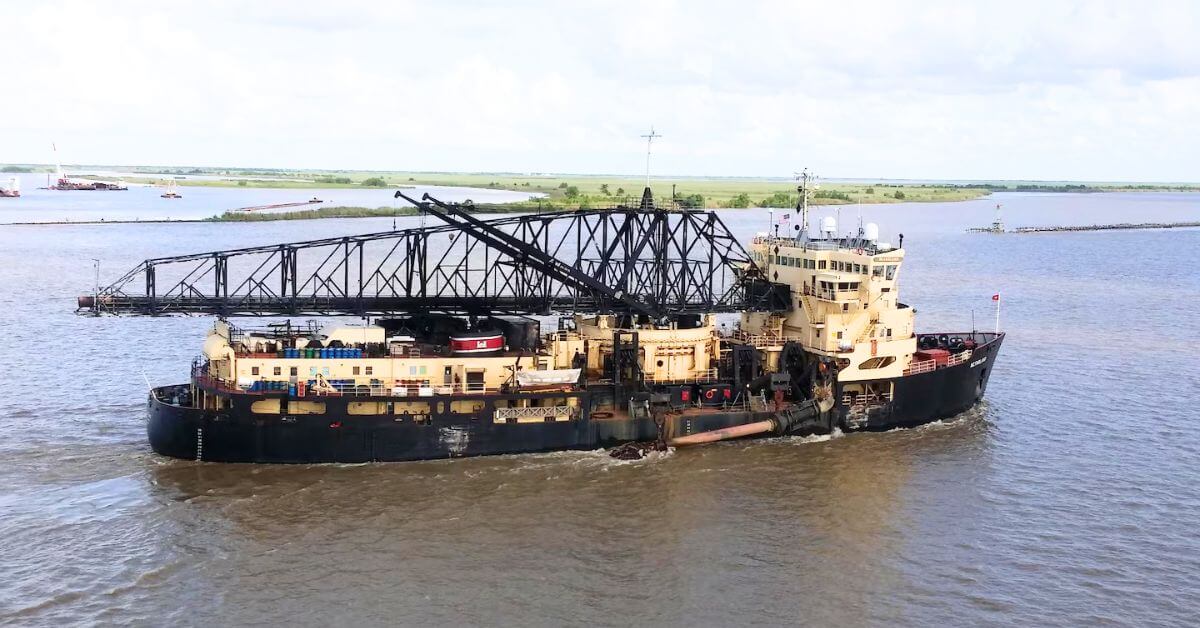
The U.S. Army Corps of Engineers Philadelphia District honored the Dredge McFarland during a farewell ceremony Oct. 23 at Fort Mifflin, marking the completion of the vessel’s final operational mission after nearly six decades of service.
Current and former crew members, members of the McFarland family, maritime partners, and stakeholders gathered along the Fort Mifflin pier to recognize the vessel and the civilian mariners who operated it on the Delaware River and waterways across the nation.
“We are joined by an extraordinary gathering of leaders, partners and friends whose presence speaks volumes about what this ship means to our region and our country,” said USACE Philadelphia District Commander Lt. Col. Ryan A. Baum.
The ceremony incorporated Army ceremonial protocol and maritime tradition. The watch was secured, and the USACE distinguishing flag was lowered and presented to family members of the vessel’s namesake, Arthur McFarland. Later in the ceremony, crew members were rung ashore, and a final whistle sounded in tribute to the vessel’s service.
“We honor the ship today. We honor the skill that kept her ready, the families who stood behind her crew, and the generations of mariners who gave her name its meaning,” said Senior Official Performing the Duties of Assistant Secretary of the Army for Civil Works Mr. D. Lee Forsgren.
With her final mission complete, the McFarland entered a pierside standby status at Fort Mifflin. The vessel will remain there while the Army Corps’ medium-class hopper dredge, the Donnelly, is under construction.
The McFarland was launched in 1966 at Bethlehem Steel’s Sparrows Point yard near Baltimore and completed in 1967.
McFarland Namesake
The dredge was named for Arthur McFarland, a respected U.S. Army Corps of Engineers dredging authority who began his career as an engineman, rose to dredge master and later became one of the Corps’ foremost leaders in the field.
Over a 40-year career, Arthur McFarland oversaw the design, construction and maintenance of dredging plants in the New Orleans and Galveston districts before joining the Office of the Chief of Engineers in Washington, D.C. When the Corps selected his name for the new hopper dredge, it honored both his technical expertise and his lifelong contributions to advancing the Army Corps’ dredging mission.
The farewell carried special meaning for the McFarland family. At the vessel’s 1966 launch and christening, Arthur McFarland’s daughter, Alice McFarland Wilson, served as sponsor, while Mrs. Arthur McFarland served as matron of honor. Sandra Wilson, Arthur McFarland’s granddaughter, attended the original ceremony as a child and returned to Fort Mifflin for the farewell. She was joined by her sister, Margo London; Phil London and Laura London, Arthur McFarland’s great-grandchildren; and James McFarland, his great-nephew.
“It was a wonderful event,” said Margo London. “We’re so glad we could be here. It was very touching.”
Legacy of Service with Three Districts
Long before the McFarland became a familiar presence on the Delaware River, the vessel served under the jurisdiction of the Galveston District and supported navigation work along the Texas coast. Its design allowed it to place dredged material through bottom discharge, sidecasting or direct pumpout, giving the Corps flexibility to meet different navigation requirements.
The McFarland was reassigned from the Jacksonville District to the Philadelphia District in 1982 and became a key part of the effort to maintain safe, reliable navigation on the Delaware River and Bay. Over its service life, the vessel dredged more than 100 million cubic yards of material and completed 11 Ready Reserve missions after entering this status in 2010.
“Ask someone who served here what they remember, and you may hear about a difficult assignment or an emergency response,” said McFarland Captain Mike Hass. “But you will also hear about the people.”
Those people stood at the center of the farewell. McFarland crews worked long deployments, navigated busy waterways and answered urgent calls that sometimes extended beyond dredging. In 2001, crew members helped extinguish a shipboard fire during an eight-hour response in the Mississippi River Gulf Outlet. In 2012, the crew stopped dredging near Morehead City, North Carolina, to rescue a boater in distress.
These incidents reflected the readiness, versatility and professionalism that defined McFarland crews throughout the vessel’s service.
As McFarland enters standby status, the Army Corps plans to preserve the vessel’s legacy through documentation, videography, artifact curation and public interpretation.
RELATED POSTS


Disclaimer :
The information on this website is for general purposes only. While efforts are made to ensure accuracy, we make no warranties of any kind regarding completeness, reliability, or suitability. Any reliance you place on such information is at your own risk. We are not liable for any loss or damage arising from the use of this website.

About Author
Aakriti is a journalist and news writer at Marine Insight, with over three years of experience covering the global shipping and maritime …Read More ->
Disclaimer :
The information on this website is for general purposes only. While efforts are made to ensure accuracy, we make no warranties of any kind regarding completeness, reliability, or suitability. Any reliance you place on such information is at your own risk. We are not liable for any loss or damage arising from the use of this website.
Subscribe To Our Daily Newsletter
By subscribing, you agree to our Privacy Policy you can unsubscribe anytime.