
A Guide To Merchant Navy Uniform (With Photos And Illustrations)
The merchant navy uniform is a matter of great pride and respect for those working at sea. It takes years of hard work, discipline and dedication for a maritime professional to become worthy of wearing the prestigious merchant marine uniform.
These smart uniforms are also a subject of great fascination not just for those in the industry but also for those who have no clue what maritime professionals do or what the industry is all about.
For some, the uniform is not just two pieces of clothes, but an experience, an achievement, and an attachment to an industry which has made them what they are today.
It’s true to say that many youngsters dream of themselves in naval uniforms. However, one needs to work hard to earn that privilege.

Related Reading: 10 Reasons Why Career In Merchant Navy Is Unlike Any Other
History of Merchant Navy Uniform
It is said that the uniform was first granted by King George V to the British merchant shipping fleets to honour their service in the First World War.
Similarly, the idea of a particular uniform for seafarers working on merchant vessels was introduced in the twentieth century, especially after the First World War.
Like other military forces worldwide, the naval forces introduced uniforms a long time ago. The officers and other crew members aboard a merchant’s vessel were allowed to choose their clothes.
Historians suggest that the work clothes of seafarers on commercial vessels were not greatly different from those worn by peasants and other working-class people.

Uniforms became part of the merchant navy’s culture after passenger ships introduced systems of stripes and badges to identify crew members from travellers.
The system also helped to identify officers from other crewmembers, such as seamen or ratings. With the successful implementation of this system abroad, the passenger ships attracted the attention of merchant ship owners in Britain and other major European countries.
According to historical documents, the merchant navy did not have an official uniform until 1918, when the British Board of Trade introduced it. According to the Royal Museums Greenwich, most merchant uniforms in the museum collection date from the 20th century, including the standard uniform introduced in 1918.
Apart from helping to identify the ranks of seafarers, the uniforms also discussed crew members’ responsibilities and promoted more discipline in their jobs. The shining epaulettes on the shoulders reflected the responsibilities performed at different times and other achievements of a seafarer.
Though the culture of uniforms on commercial vessels continued until the 1970s, the later years saw people moving away from such formal characteristics, especially on merchant vessels. While the crew working on passenger vessels continued to be dressed in their uniforms, the crew on other commercial vessels focused more on operational capabilities, making other sophisticated elements optional.
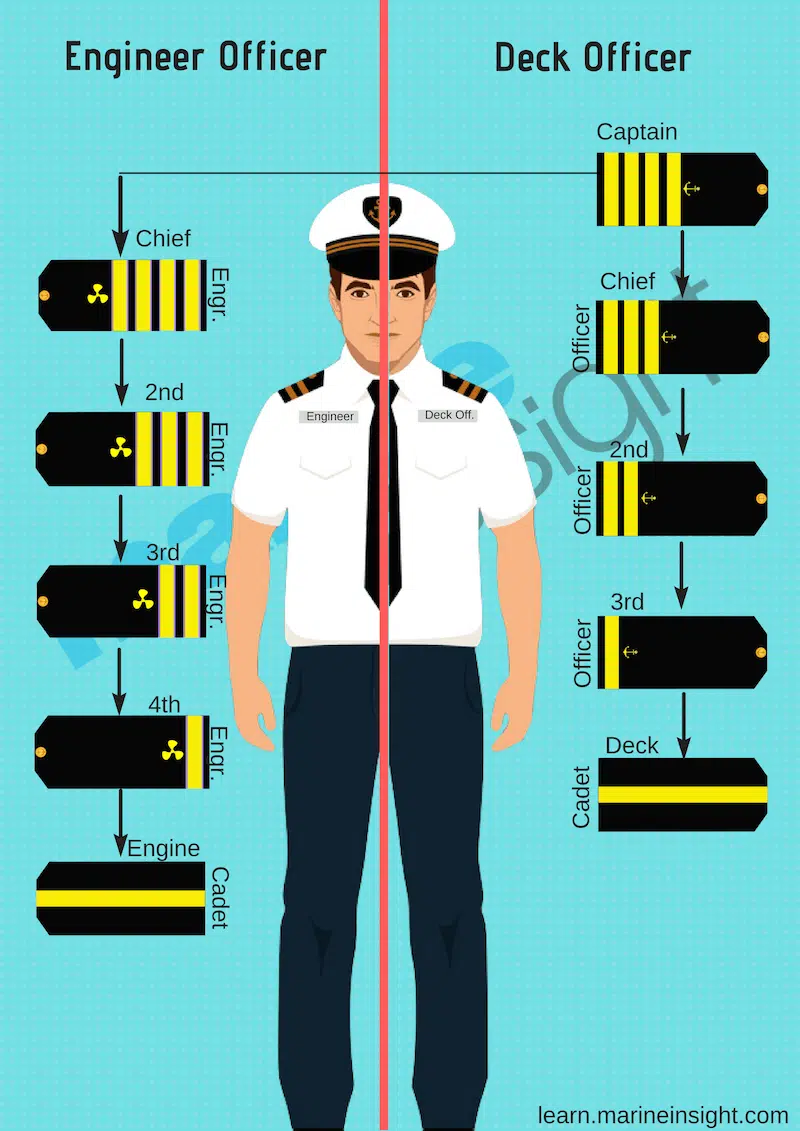
At the same time, Merchant Navy cap badges were also issued in Britain. In terms of Insignia, the uniforms with full golden stripes are meant for deck officers, while engineer officers will have golden stripes with purple colour in between on their uniforms.
Gold stripes with green and red colours are used on the uniforms of electrical officers and medical officers. The electrical officer wears the same stripe as a 3rd engineer or 2nd officer.
The crew working as the chief steward or in the hospitality department will have golden stripes with white colour. The uniform with wavy stripes and a diamond in between is for radio officers aboard the vessels.
At the same time, merchant navy uniforms featuring stripes with diamonds can only be worn by Officers having a Certificate of Competency (COC). However, the features of merchant navy dress display slight differences from country to country.
Similarly, the colours used between the stripes on the uniform also act as an element to differentiate the crew members according to their occupational hierarchy on board the vessel. Known as Merchant Navy Insignia, these designs were first issued for the merchant navy in the 1940s by Admiralty, Britain.
Currently, seafarers aboard commercial vessels, especially those working in the engine room or on deck, wear boiler suits as their usual uniform, while mariners working as bridge watchkeepers and masters prefer a simple white pilot shirt and black trousers.
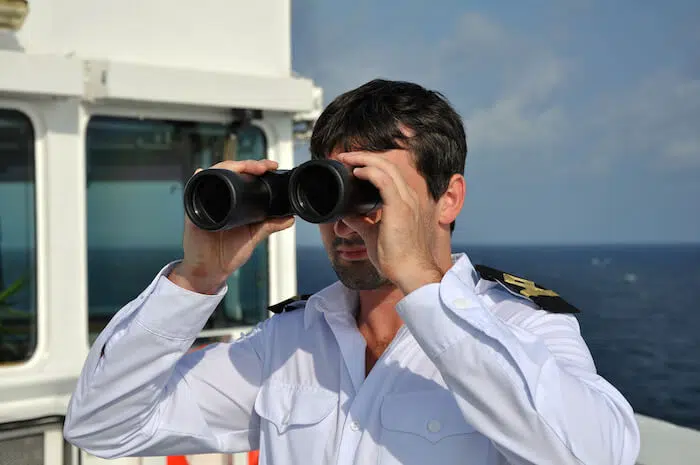
Merchant Navy Uniform On Ships (Illustration)
In addition to helping identify the crew members from the passengers, the use of uniforms also helped the crew develop unity and solidarity among themselves and professionalism throughout the vessel, leading to improved service delivery.
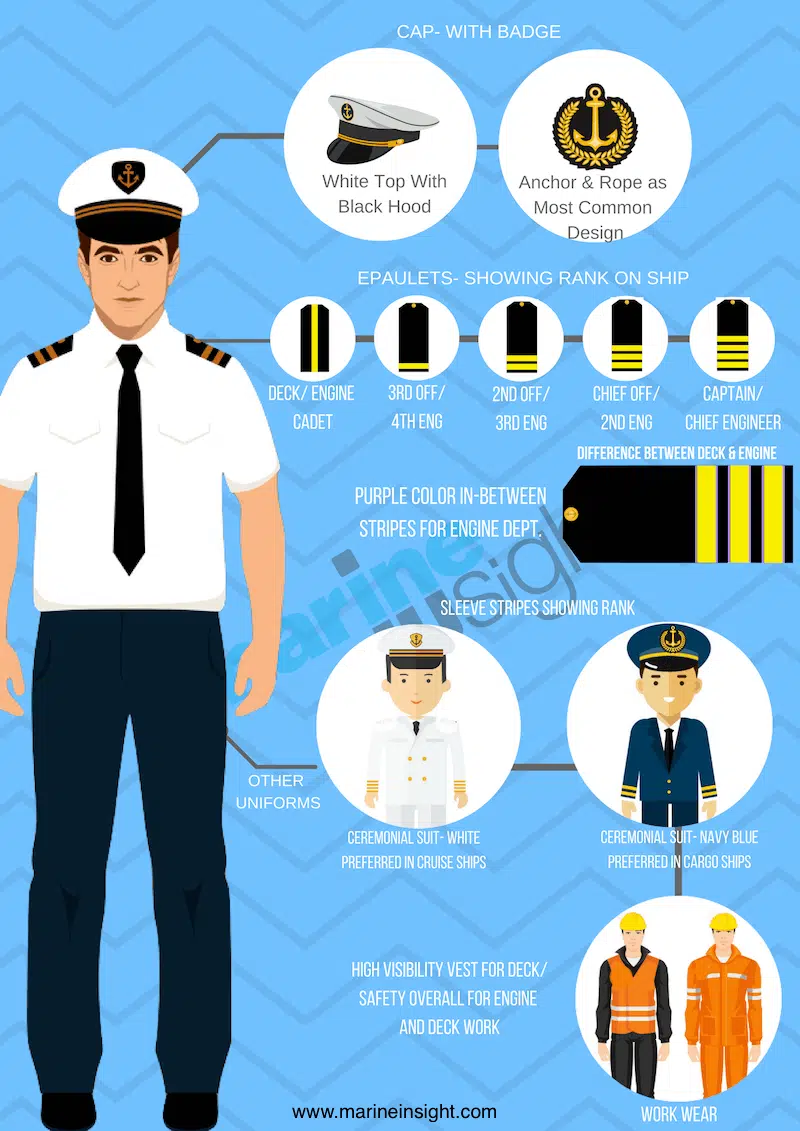
What a maritime professional wears on board ships also depends on the type of vessel and the nature of the work he/she performs. For example, as mentioned earlier, a mariner working on deck or in the engine room will wear boiler suits and a high-visibility vest or safety accessories such as gloves, helmets, safety shoes, etc. The officer uniform on a cruise ship might differ a bit from those worn on merchant vessels.
Related Reading: A Guide To Merchant Navy Ranks

Like any other uniforms used across different workplaces, the merchant navy uniforms also carry specifications explaining the person who wears them. It helps to create a professional identity and demonstrates occupational hierarchies among the crew members.
While the elements of a merchant navy’s uniform resembled many of the features of a naval uniform, they all often carried different meanings. Though modern seafarers use more trendy uniforms, some features of the older versions of the merchant navy uniform have remained similar throughout the years.
Merchant Navy Uniform Diagram – Engineer Officer Vs Deck Officer
Deck Department Uniform
Deck crew (and officers) usually wear a white shirt and black trousers with epaulettes according to their rank when on the ship’s bridge, accommodation, or mess area. The uniform is accompanied by black formal shoes and a pullover or sweatshirt during cold conditions. The cap (P-cap) is a black hood with a white top bearing an anchor symbol.
While working on deck or during cargo operations, they can usually be seen wearing a boiler suit along with other personal protective equipment. Ratings from the deck department also wear the same boiler suit and safety shoes.

Engine Department Uniform
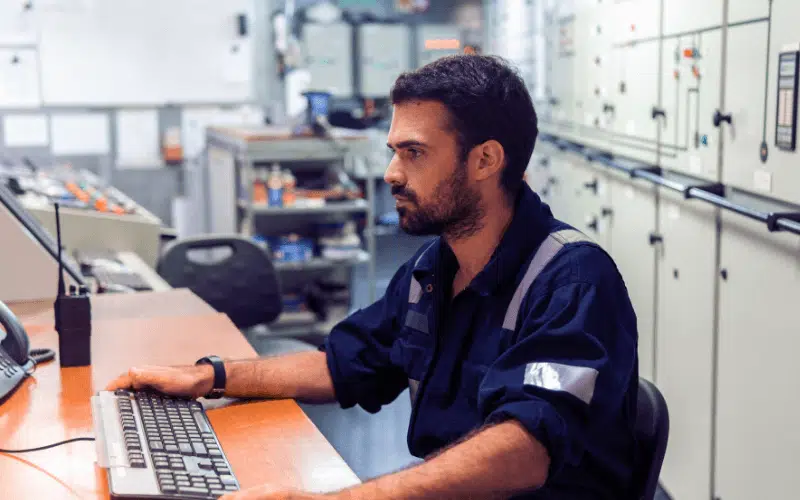
As the engine department crew spends most of the time in the engine room, they are always in boiler suits, except when they are in the officer’s mess or on the bridge. (However, during lunch hours, they can be allowed to have food in boiler suits because of the time constraint.)
The formal uniform of engineer officers is the same as that of deck officers; however, the epaulettes change according to rank. (Engineer officer epaulettes also have purple between stripes. They also have a propeller symbol, whereas those of deck officers have an anchor.) The P-Cap is the same as that of the deck department.
The engine room ratings also mainly wear boiler suits and safety overall.

Ratings Uniform in Merchant Navy
As mentioned earlier, ratings belonging to both engine and deck departments usually wear boiler suits during work. The cook and ordinary seaman mainly wear a white shirt, black trousers, and formal black shoes (or safety shoes).

As is practised across all other workplaces, the crew of commercial vessels are allotted separate uniforms according to their ranks. The uniforms of commercial vessel crew members sometimes also display the company cap badge and other popular badges.

Today, merchant navy officers’ uniforms and other dress codes have changed immensely. The uniforms’ design has improved a lot, and of course, the youth’s fascination with being part of that community has also increased to a noticeable level.
Over to you..
Do you love your merchant navy uniform?
Let us know in the comments.
Disclaimer :
The information on this website is for general purposes only. While efforts are made to ensure accuracy, we make no warranties of any kind regarding completeness, reliability, or suitability. Any reliance you place on such information is at your own risk. We are not liable for any loss or damage arising from the use of this website.
Disclaimer :
The information on this website is for general purposes only. While efforts are made to ensure accuracy, we make no warranties of any kind regarding completeness, reliability, or suitability. Any reliance you place on such information is at your own risk. We are not liable for any loss or damage arising from the use of this website.
Related Articles



About Author
Journalist by training, and an academic in aspiration, Shamseer Mambra currently works as a freelance journalist, after spending three years in the newsrooms of some of the reputed media houses in India. When not at work, he likes to read, click photographs and go for a ride on his bike.
Subscribe To Our Daily Newsletter
By subscribing, you agree to our Privacy Policy you can unsubscribe anytime.


There is no word about Electrical officer.
Am proud to be among of them.
“Marine Engineer”.now retired.
My last post marine suprintendent.
where is the ETO ?
Where is ETO?
We have mentioned the details of ETO inside the article. It is not shown in the image.
According to the STCW, ETO = Electro Technical Officer
Shouldn’t there be a 1st. Engineer too with 3 stripes, 2nd. Engineer then with 2 stripes?
Marine Insight very disappointing depiction…how come chief officer is above Second Engineer …Nowadays I am seeing this trend of Chief Officers(esp Indian ) think they are equal to Chief Engineer and try unsuccessfully to boss around Second Engineer …This depiction of yours is very unfortunate and I would say hurtfull to self respecting engineers , who believe Chief Engineers is equivalent if not equal to Captains … I would add one more point usually Chief Officers need help of Second Engineer not the other way round …. Please modify or remove this post ….
@Sidhart: The diagram just shows the interdepartmental ranks. The spacing of the epaulettes does not indicates the superiority of any rank. However, as per ISM, the captain is considered to be the overall in-charge out of all ranks. Except that, rest of the ranks position is just for diagrammatical representation purpose. As shown in the other diagram, the rank/function of Chief officer and second engineer in their respective department is similar.
@Jostein: The number of stripes varies from region to region.
On board ship, ETO is a most wanted, importent person who do most critical works along (as one person army) most of the time. But intentionally neglected person by most of the fellow colleagues…. Sorry to say
stripes dont mean much to me, attitude and work ethic is much more meaningful to all on board. just saying.
@Pat: Well said ??
You are absolutely right, sir!
I really liked the article. To the point. Even lay man can understand. Also liked the brief description on the inception of uniforms.
keep up the good work.
@Girish: Thank you for your comment ??
Just like to point out that your whole page seems to contain a lot of errors.
You seem to continuously refer to Engineers and “Officers”.
Engineers ARE Officers, what you are referring to as Officers are in fact Mates, it says so on their CoC’s
Please use the correct terminology, either Deck and Engineering officers, or Engineers and Mates.
Thank you.
I love marchant navy officer
Uniforms silly except on passenger ships;work uniforms should be khaki not dress colors. Virtually no Anerican seamen wear uniforms any more