

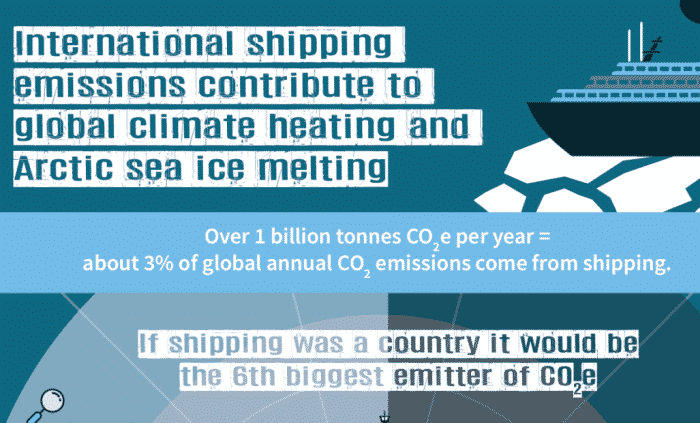
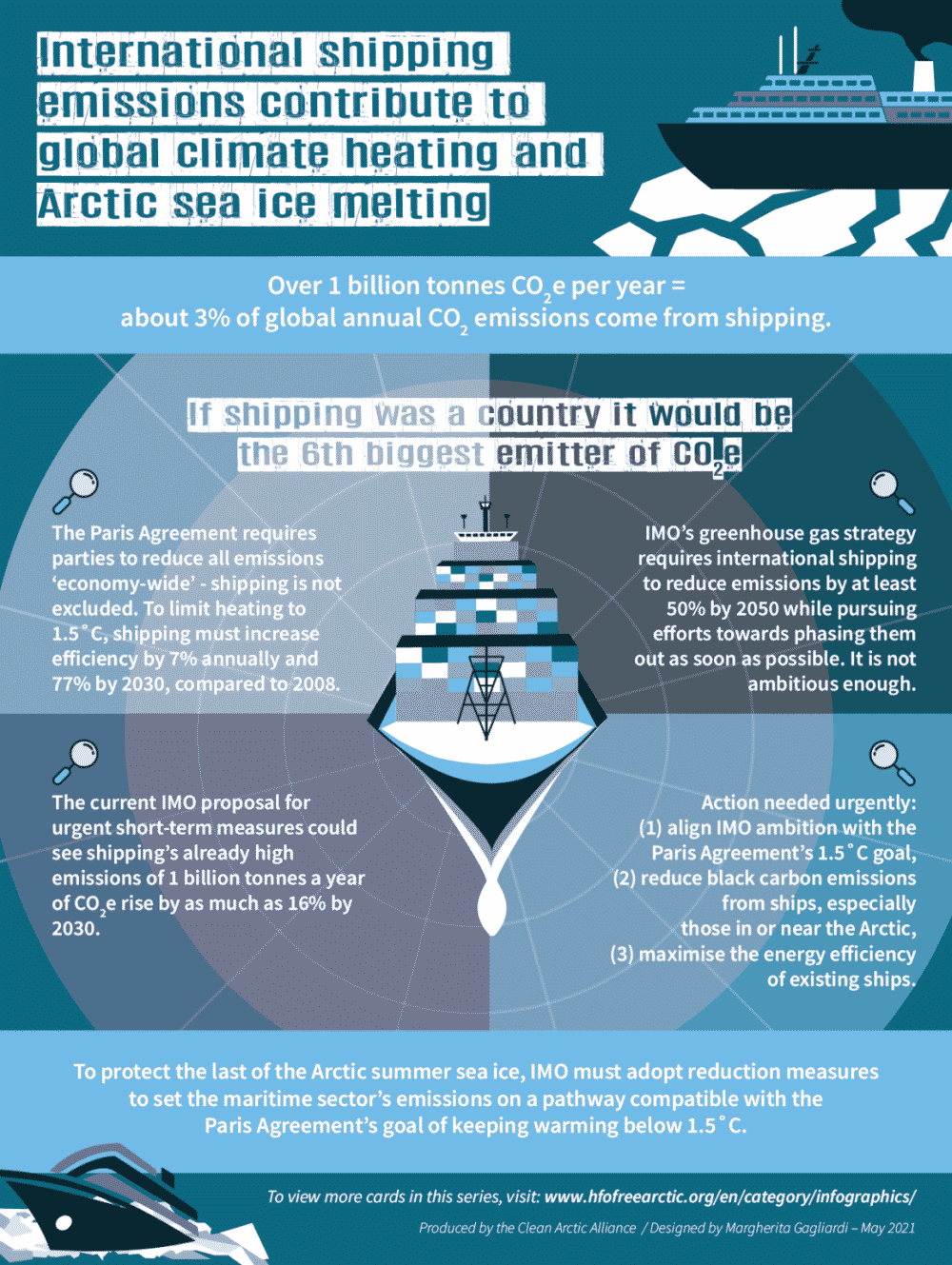
Infographic: Arctic Demands Global Action For Protection From Impacts Of Shipping Emissions
As a meeting of the International Maritime Organization’s (IMO) Marine Environment Protection Committee opens today (MEPC 76), IMO member states were called on to take urgent and immediate action to protect the Arctic from the impacts of shipping emissions and pollution.
“I would like to stress the need for urgent action to reduce shipping’s climate warming impacts on the Arctic”, said Austin Ahmusak, Kawerak Marine Advocate, from Nome, Alaska during an address to the IMO.
“The disaster that I am living is a disaster that is personal to me, but it is also personal to each and everyone of us and especially to the planet. We in the Arctic are convinced that the Arctic is clearly in crisis and the change is happening rapidly, beyond comparison in human history or in our indigenous knowledge.”
“Last month, the Arctic Council released a new report concluding that the Arctic is warming three times faster than the average heating across the whole planet and we face the possibility that major portions of the cryosphere will be gone. Climate heating in the Arctic threatens the global climate and sea level rise around the world is an immediate concern for low-lying cities. A two metre sea level rise will have devastating impacts in many coastal communities and will likely put community infrastructure underwater.”
“Bolder action to protect the Arctic is urgently needed. The whole world looks to the IMO to address international shipping’s contribution to the Arctic climate crisis – in hope it will take meaningful action to reduce both emissions of greenhouse gases as well as emissions of black carbon”
“An ambitious and effective short term GHG measure consistent with the Paris Agreement temperature goals is needed, as is immediate action to cut black carbon emissions from ships in or near the Arctic.
During the meeting, which runs from 10-17 June, IMO member states are set to adopt a regulation banning the use and carriage of heavy fuel oil (HFO), which NGOs have criticised as too weak and too late – it will not be fully implemented until 2029.
The meeting will also feature a proposal for a resolution to address black carbon pollution in the Arctic, while a package of “short-term measures” on greenhouse gas emissions (GHG) is set to be adopted.
“Last month, Arctic Foreign Ministers warned that the Arctic is now warming three times faster than the planet as a whole”, said Dr Sian Prior, Lead Advisor to the Clean Arctic Alliance. “When it comes to the climate, the Arctic is the planet’s early warning system – and it is clear that the Arctic is in crisis. If the Arctic is in crisis – then we are all in crisis.”
“The changing climate in the Arctic including loss of summer sea ice is already resulting in declines in wildlife populations and impacts for Indigenous communities, while the melting of Arctic glaciers and the Greenland ice sheet will contribute to sea level rise for the whole planet. During MEPC, the IMO Member States must commit to bolder action on both black carbon and greenhouse gas emissions if we are to have any hope of retaining the Arctic’s summer sea ice”, added Prior.
“The Arctic climate crisis requires urgent action to rapidly reduce both black carbon and carbon dioxide emissions from all sources including international shipping. The Clean Arctic Alliance is calling on IMO member states to support the adoption at MEPC 76 of a Black Carbon Resolution which calls for a voluntary switch to distillate or alternative, cleaner fuels while operating in or near the Arctic [6]. IMO member states must also be ambitious and hold the IMO to account by adopting strong measures to reduce CO2 emissions and keep aligned with the Paris Agreement’s 1.5oC goal.”
“In addition, the IMO and its member states must take collective responsibility for failing to put in place true protection of the Arctic, Indigenous communities and wildlife from the threat of heavy fuel oil. In its current form, the proposed ban will achieve only a minimal reduction in HFO use and carriage by ships in the Arctic in mid-2024, when it comes into effect. It will be crucial that Arctic coastal states do not resort to issuing waivers to their flagged vessels or the ban will not have the necessary impact anytime soon”, she concluded.
Other issues due to be considered during MEPC 76 include the discharge of wastewater from the use of exhaust gas cleaning systems or “scrubbers” and the impact of underwater noise. Scrubbers allow the continued use of heavy fuels with a high sulphur content since the sulphur is removed from the exhaust emissions, but the wastewater from the scrubber, which also contains heavy metals and polyaromatic hydrocarbons, is dumped in the ocean. The Clean Arctic Alliance is calling for the use of scrubbers to be banned in Arctic waters.
Another issue, that of underwater noise, has not been considered by the IMO and its member states for some years and the Clean Arctic Alliance is also calling for underwater noise to be included back onto the agenda of the MEPC meeting so that consideration can be given to measures to reduce the impact.
Press Release
Do you have info to share with us ? Suggest a correction
About Author
Marine Insight News Network is a premier source for up-to-date, comprehensive, and insightful coverage of the maritime industry. Dedicated to offering the latest news, trends, and analyses in shipping, marine technology, regulations, and global maritime affairs, Marine Insight News Network prides itself on delivering accurate, engaging, and relevant information.

About Author
Marine Insight News Network is a premier source for up-to-date, comprehensive, and insightful coverage of the maritime industry. Dedicated to offering the latest news, trends, and analyses in shipping, marine technology, regulations, and global maritime affairs, Marine Insight News Network prides itself on delivering accurate, engaging, and relevant information.

Subscribe To Our Newsletters
By subscribing, you agree to our Privacy Policy and may receive occasional deal communications; you can unsubscribe anytime.