

Real Life Incident: Fatal Accident On First Day After Promotion To Floor Hand Position
An incident resulting in a single fatality occurred onboard a drillship in the Gulf of Mexico during pipe-handling operations. A floor hand, standing in the setback area, died when he was struck in the head by the bottom end of a 6⅝-inch drill pipe as it was being moved from its storage location to the main drill center.
The drill crew was in the process of tripping drill pipe in the hole. The victim had been assigned to spot for the assistant driller who operated the main pipe racker from inside the drill shack. The victim was responsible for visually verifying that the latches on the lower and upper fingerboards were in the open position prior to the retracting of the racker arms. The victim who was not in the direct line of sight of the assistant driller would verbally convey the position of the latches (open or closed) via hand-held radio. In addition to spotting, the victim had also been tasked with keeping the setback area clean, applying thread lubricant to the stands and re-numbering the stands with a paint stick.
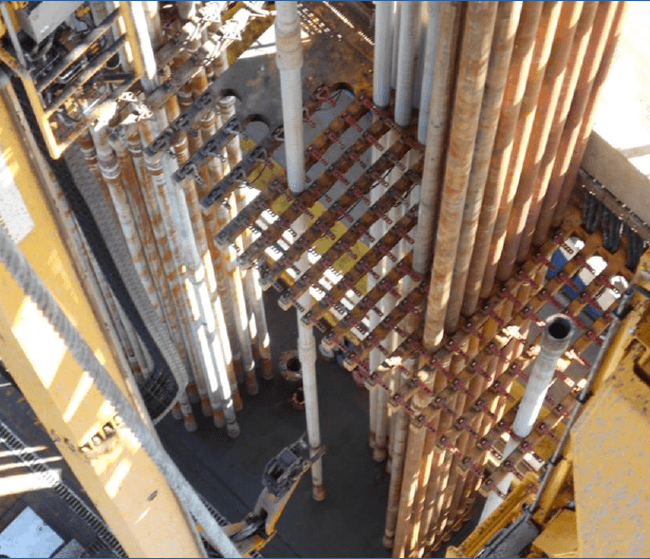
The victim was newly promoted from roustabout to floor hand. The day of the incident was the victim’s first day in the new position.
After the victim reported that the latches were in an open position, the assistant driller began the process of removing a drill pipe stand with the main pipe racker. However, as the pipe racker arms retracted, the stand was obstructed by a closed latch on the lower fingerboard. The stand of pipe began to bow as it was pulled against the closed fingerboard latch. The victim was standing in the setback area. The stored energy from the stand being bowed was released and it recoiled toward the setback area striking the victim. From the start of the sequence to the time the victim was struck, six to eight seconds had passed.
The BSEE panel investigation concluded that this fatality was the direct result of the finger board latch not opening properly and the victim being in the setback area when the stand being held under tension released. Multiple tasks were assigned to the victim that required that he enter the setback area. His inexperience and lack of consistent training about when it was permissible to enter the setback area may have contributed to the victim’s decision to step into the setback area when he did.
Therefore, BSEE recommends that companies operating on the U.S. Outer Continental Shelf:
- Evaluate all tasks included in an operation when making work assignments and evaluate how each planned task relates to the others.
- Review Short Service Employee programs to orient personnel new to a position.
- Review on-the-job training programs. Consider formalizing the programs to provide continuity between those conducting the training and the content of the training.
- When using a spotter to verify the position of finger board latches, review where that task can be safely performed. Consideration should be given to the spotter’s proximity to the moving pipe stands. No tasks should be assigned to a spotter that places the spotter in setback areas during pipe handling operations.
Reference: bsee.gov
Do you have info to share with us ? Suggest a correction
About Author
Marine Insight News Network is a premier source for up-to-date, comprehensive, and insightful coverage of the maritime industry. Dedicated to offering the latest news, trends, and analyses in shipping, marine technology, regulations, and global maritime affairs, Marine Insight News Network prides itself on delivering accurate, engaging, and relevant information.

About Author
Marine Insight News Network is a premier source for up-to-date, comprehensive, and insightful coverage of the maritime industry. Dedicated to offering the latest news, trends, and analyses in shipping, marine technology, regulations, and global maritime affairs, Marine Insight News Network prides itself on delivering accurate, engaging, and relevant information.

- Real Life Incident: Vessel Collision in Good Visibility

- Real Life Incident: Severe Injury To Deck Crew While Leaving Berth
- Real Life Incident: Departure Damage in Very Restricted Waterway
- Real Life Incident: Low Situational Awareness Has High Impact Consequence
- Real Life Incident: Fouled Anchor in a Designated Anchorage
- Real Life Incident: Fire On Barge Carrying Scrap Metal Causes $7 Million Worth Of Damage

Latest Case studies Articles You Would Like:

Subscribe To Our Newsletters
By subscribing, you agree to our Privacy Policy and may receive occasional deal communications; you can unsubscribe anytime.
Web Stories