


What are Ro-Ro Ships?
Ro-Ro is an acronym for Roll-on/roll-off. Roll-on/roll-off ships are vessels that are used to carry wheeled cargo.
The roll-on/roll-off ship was defined in the November 1995 amendments to Chapter II-1 of the International Convention for the Safety of Life at Sea (SOLAS), 1974 as being “a passenger ship with ro-ro cargo spaces or special category spaces”
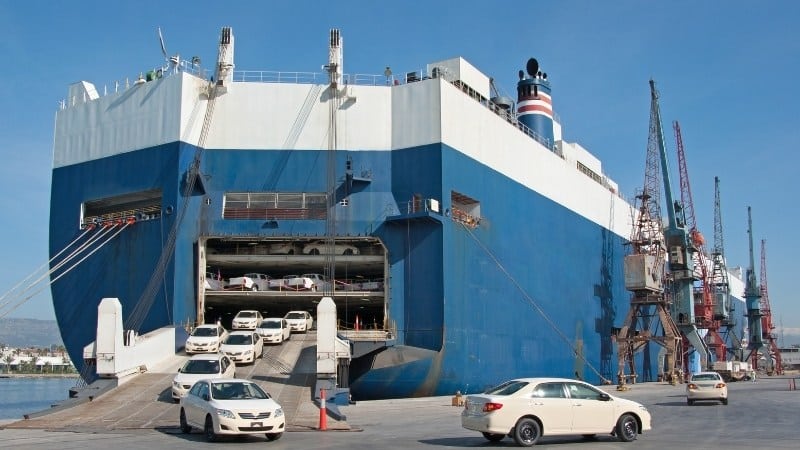
The ro-ro ship is different from Lo-Lo (lift on-lift off) ship that uses a crane to load the cargo. The vehicles in the ship are loaded and unloaded by means of built-in ramps. Normally these ramps are made towards the stern (backside) of the ship. In some ships, they are also found on the bow side (front) as well as the sides. The vessel can be of both military and civilian types.
Ro-Ro vessels were being built in the 19th century to transport trains, too wide for the bridges, across rivers.v
An example of a Ro-Ro vessel is the Firth of Forth ferry which started operations in 1851. The rails were laid on the ship so that it could be connected to the ones on land. A train would then simply roll onto the ship and then roll off at the other end.
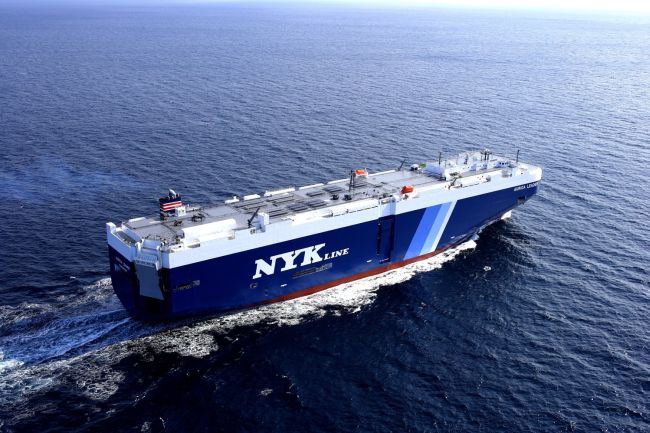
There are various types of ro-ro vessels, such as ferries, cruise ferries, cargo ships, and barges. The ro-ro vessels that are exclusively used for transporting cars and trucks across oceans are known as Pure Car Carriers (PCC) and Pure Truck & Car Carriers (PCTC) respectively.
Related Read: The Dangers of Ro-Ro Ship Design: A Naval Architect’s Perspective
Unlike other cargos that are measured in metric tonnes, the ro-ro cargo is measured in a unit called lanes in meters (LIMs). LIM is calculated by multiplying cargo length in meters by the number of decks and by its width in lanes. The lane width will differ from vessel to vessel and there are a number of industry standards.
The largest ro-ro passenger ferry is MS Color Magic. It weighs 75,100 GT (Gross Ton). It entered the service in September 2007 for Color Line. It was built in Finland by Aker Finnyards. The ferry is 223.70 m long, 35 m wide and can carry 550 cars as well as 1270 lane meters of cargo.
The ro-ro passenger ferry with the greatest car-carrying capacity is the Ulysses. The ferry was named after a novel by James Joyce and is owned by Irish Ferries. It entered the service on 25 March 2001 and operates between Dublin and Holyhead. It weighs 50,938 GT and is 209.02 m long and 31.84 m wide. It can carry 1342 cars and 4101 lane meters of cargo.
Related Read: Different Types of Ferries Used in the Shipping World
Advantages of a ro-ro ship
A ro-ro ship offers a number of advantages over traditional ships. Some of the advantages are as follows:
- For the shipper, the advantage is speed. Since cars and lorries can drive straight on to the ship at one port and then drive off at the other port within a few minutes of the ship docking, it saves a lot of time of the shipper.
- It can also integrate well with other transport development, such as containers. The use of Customs-sealed units has enabled frontiers to be crossed with the minimum of delay. Therefore, it increases the speed and efficiency of the shipper.
- The ship has also proved extremely popular with holidaymakers and private car owners. It has significantly contributed to the growth of tourism. A person can take his car from one country to another by the sea with the help of a ro-ro vessel.
Variations of a ro-ro ship
The certain variations of a ro-ro ship are as follows:
Pure Car carriers(PCC) /Pure Car Truck Carriers (PCTC)
Pure Car carriers(PCC) /Pure Car Truck Carriers (PCTC)have a box-like framework, with the arrangement of ramps to load and unload the cargo. The pure car carrier is used to transport only cars whereas PCTC is used to transport all types of vehicles.
These consists of a quarter ramp in a stern, 2 ramps on both the sides, covered internal ramps and hostable decks are used to transfer the cars into multi-level decks. Vehicles drive directly into the ship and via internal ramp system to various decks.
Related Read: World’s First Dual Fuel LNG PCTC
ROPAX
ROPAX is an acronym for roll on/roll off a passenger. It is a ro-ro vessel built for freight vehicle transport with passenger accommodation. The vessels with facilities for more than 500 passengers are often referred to as cruise ferries.
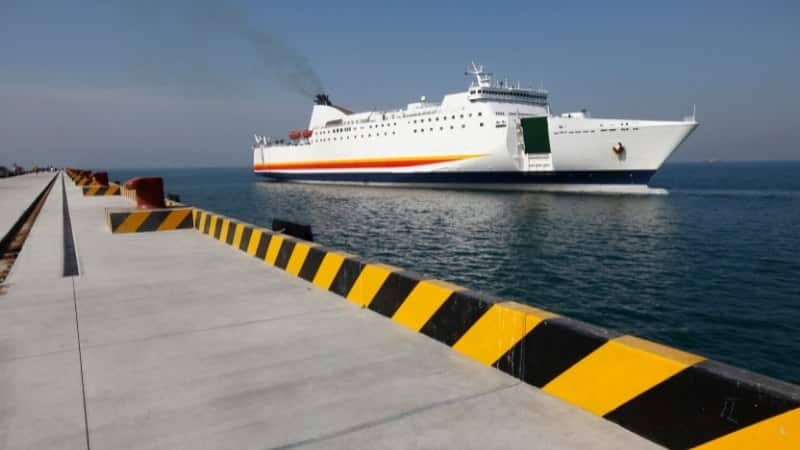
RoPax is basically used for short sea transport. These vessels comply with both the international standards which apply to a passenger ship as well as to a Ro-Ro. ROPAX traffic is unevenly distributed all over the world. Its traffic can mostly be found in the seas of Northern Europe
RoLo
RoLo is an acronym for roll-on lift-off vessel. It is also a hybrid vessel type with ramps serving vehicle decks but the other cargo decks are accessible only by crane.
These vessels are capable of carrying both Vehicles and general cargo or heavy metals. Since the weight of general cargo items or the Heavy metal pieces may exceed the payload of the ramp, ship/shore cranes can be used to load and discharge the cargo directly into the hold.
ConRO
The ConRo vessel is a hybrid between a ro-ro and a container ship. This type of vessel uses the area below the decks for vehicle storage while stacking containerized freight on the top of the decks.
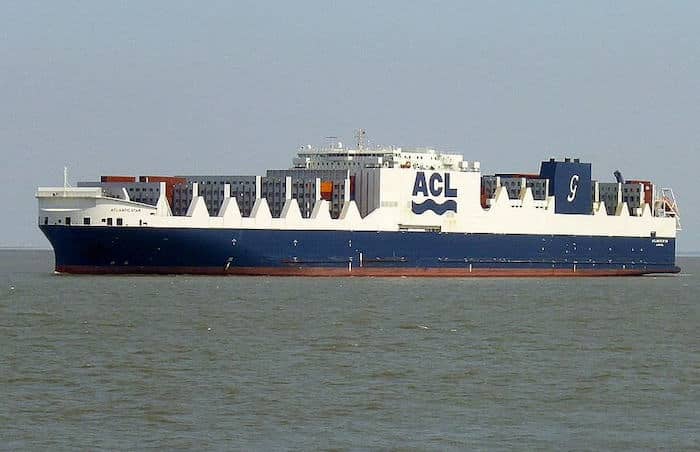
In some vessels, there are such arrangements where the vessel is divided into 2 parts, the underdeck of one side has cell guides wherein the containers can be loaded and the other side underdeck has all arrangements for carrying cars or other such vehicles. Full cargo carrying space on deck is used for carrying containers.
Related Read: Top 10 World’s Largest Container Ships In 2019
In these vessels, the loading and discharging operation need utmost care and diligence as the weight distribution difference may affect the vessel’s stability. The windage area of these type of vessel is less as compared to any other Ro-Ro vessels. It was introduced in the 1950s.
Roll-on/Roll-off Ships Stowage and Securing of Vehicles
Principal Sources of Danger
Though Ro-Ro vessel’s make a very small proportion of the Merchant marine tonnage, there have been many accidents involving these, giving rise to far worse consequences. It is very important to understand the “Sources of Danger “which leads to such petrifying situations. These sources of danger don’t only affect the safety of roll-on/roll-off vessels but also the passenger/crew in it.
- The unacceptable condition of the consignment constraining it to be properly lashed for Sea. Example: insufficient number and incorrect positioning of securing points, Weak securing points etc.
- The free surface effect in tank vehicles and tank containers which are slack;
- Poorly maintained ramps, lifts and bow and stern doors;
- Poorly maintained, inadequately illuminated or badly planned decks;
- Wet Decks;
- Vehicles being moved negligently on vehicle decks and ramps;
- The reversing of road vehicles on vehicle decks and ramps;
- Insufficient or incorrectly applied lashings or wrong use of Lashing equipment or of inadequate strength having regard to the mass and centre of gravity of the vehicle and the weather conditions likely to be encountered during the voyage;
- Free play in the suspension of vehicles;
Related Read: 8 Reasons That Make Ro-Ro Ship Unsafe to Work On
Stowage
The Ro-Ro’s s are true workhorses of Sea. Their versatility to transport diverse cargo and short port stay show their efficiency. The cargo carrying capacity of any vessel increases the vessels earning efficiency. So, It is very important to make optimal utilisation of cargo space which has been inherently problematic with the Ro-Ro concept, in order to contrive optimal stowage plans.
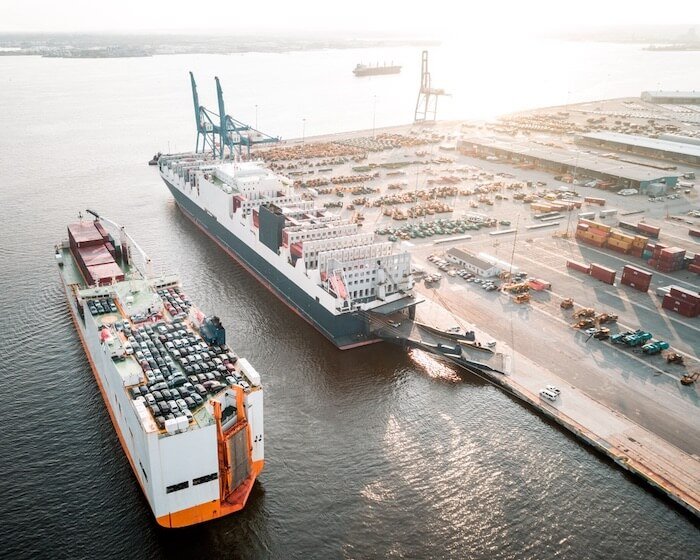
Below are the few basic points we must remember while stowing cargo in Roll on-Roll Off vessels:
- Shippers’ special advice or guidelines regarding handling and stowage of individual vehicles should be observed.
- Vehicles should, so far as is possible, be aligned in a fore and aft direction.
- Vehicles should not be stowed across water spray fire curtains.
- Vehicles should be closely stowed athwartships so that, in the event of any failure in the securing arrangement’s or from any other cause, the transverse movement is restricted. However, sufficient distance should be provided between vehicles to permit safe access for the crew and for passengers getting into and out of vehicles and going to and from accesses serving vehicle spaces.
- Safe means of access to securing arrangement’s, safety equipment, and operational controls should be provided and properly maintained. Stairways and escape routes from spaces below the vehicle deck should be kept clear.
- Vehicles should not obstruct the operating controls of bow and stern doors, entrances to accommodation spaces, ladders, stairways, companionways or access hatches, fire fighting equipment, controls to deck scupper valves and controls to fire dampers in ventilation trunks.
- Parking brakes, where provided, of each vehicle or of each element of a combination of vehicles should be applied.
- Semi-trailers should not be supported on their landing legs during sea transport unless the landing legs are specially designed for that purpose and so marked (see paragraph 4.1.4).
- Semi-trailers should not be supported on their landing legs during sea transportation unless the deck plating has adequate strength for the point loadings.
- Uncoupled semi-trailers should be supported by trestles or similar devices placed in the immediate area of the drawplates so that the connection of the fifth-wheel to the kingpin is not restricted.
- Depending on the area of operation, the predominant weather conditions and the characteristics of the ship, freight vehicles should be stowed so that the chassis is kept as static as possible by not allowing free play in the suspension. This can be done by securing the vehicle to the deck as tightly as the lashing tensioning device will permit or by jacking up the freight vehicle chassis prior to securing or, in the case of compressed air suspension systems, by first releasing the air pressure where this facility is provided.
- Since compressed air suspension systems may lose air, adequate arrangements should be made to prevent the slackening off of lashings as a result of air leakage during the voyage. Such arrangements may include the jacking up of the vehicle or the release of air from the suspension system where this facility is provided.
There are also certain difficulties faced by cargo operators in the stowage of cargo in Ro-Ro Ships:
- Cargo stowage on deck
- Various types or varieties of Cargo
- Shape of Cargo
- Securing the cargo within the unit
- The lack of transverse bulkheads
- Loading conditions
- Stability and rolling periods
Securing
Proper securing of any cargo is of utmost importance to the Safety of life at sea. The shape of a Ro-Ro is such that any condition of instability can lead to a disaster. Even according to a DNV survey, ”Shifting of Cargo” has been one of the major reason for Marine accidents involving Ro-Ro’s.
Related Read: The Basics of Cargo Lashing and Securing on Ships
Below are some important points to consider:
- Securing operations should be completed before the ship proceeds to sea.
- Persons appointed to carry out the task of securing vehicles should be trained in the use of the equipment to be used and in the most effective methods for securing different types of vehicles.
- Persons supervising the securing of vehicles should be conversant with the contents of the Cargo Securing manual.
- Freight vehicles of more than 3.5 tonnes should be secured in all circumstances where the expected conditions for the intended voyage are such that movement of the vehicles relative to the ship could be expected. So far as is reasonably practicable the securing arrangements should be adequate to ensure that there will be no movement from any cause which will endanger the ship.
How safe are Ro-Ro’s
Commercially Ro-Ro’s have always been successful due to its flexibility, integration and operational speed. Despite being commercially successful. Ro-Ro’s have always been criticised for its design and is also said to be one of the reasons for the disturbing accidents involving Ro-Ro’s. Mainly the concerns are from the safety point of view. Some of them are listed below:
- The lack of internal bulkheads
- Cargo access door
- Stability
- Low freeboards
- Cargo stowage and securing
- Life-saving appliances
- The crew
As per IMO’s circular released in January 2017, nearly 2/3rd of the lives lost at sea was from the accidents of Ro-Ro’s only. This shows that the effect of Marine accidents involving Ro-Ro’s has enormous consequences. Many steps were taken by IMO in order to reduce these accidents and some of them left an implacable effect on this industry too. Improving safety onboard Ro-Ro’s has been one of the major topics of discussion.
The only introduction of new laws, rules or conventions doesn’t change the picture. One of the studies on causes of Major accidents reflects that shift of cargo and operational faults has been the major accidents of all these accidents. These accidents were the result of improper implementation of the regulations and through Human errors.
This type of ships are more complex both in construction and operation.so any error can lead to catastrophic consequences, because of the Passengers present in the ship.
Disclaimer: The authors’ views expressed in this article do not necessarily reflect the views of Marine Insight. Data and charts, if used, in the article have been sourced from available information and have not been authenticated by any statutory authority. The author and Marine Insight do not claim it to be accurate nor accept any responsibility for the same. The views constitute only the opinions and do not constitute any guidelines or recommendation on any course of action to be followed by the reader.
The article or images cannot be reproduced, copied, shared or used in any form without the permission of the author and Marine Insight.

About Author
Raunek Kantharia is a marine engineer turned maritime writer and entrepreneur. After a brief stint at the sea, he founded Marine Insight in 2010. Apart from managing Marine Insight, he also writes for a number of maritime magazines and websites.
Latest Type Of Ships Articles You Would Like:
Do you have info to share with us ? Suggest a correction

Subscribe To Our Newsletters
By subscribing, you agree to our Privacy Policy and may receive occasional deal communications; you can unsubscribe anytime.
Web Stories
Really Good information. Never knew about such RORO vessels. Any chance such vessels coming into Indian Ports. I have Ph.D in Logistics Management with indepth study in vehicle transportation, hence interested more on this.
Hello. I am trying to find the size and number of vehicle decks for the RO RO passenger ship MS Excellent. Would you have any idea how I could get that data.
Best wishes,
Bob Walsh
Above information is too good i have studied about ro-ro in my subject but i got detail explanation about ro-ro hear.Thank you for the useful information…
Dear sir,
I need to know all safety regarding car carrier, any different for lsa, ramp safety etc.
We know it’s important for you to get a quick response for your question.
Thus, we created Marine Insight Forums >> https://forums.marineinsight.com
Difference between ro ro ship and car carrier????
@Ashutosh : RO/RO ships are designed to carry a mixture of both cars and freight (for eg. Containers) and car carriers are only for carrying vehicles.
HI DEAR
HOW ARE YOU?WE ARE MR FRANCOIS AKPA THE SON OF THE SENIOR SISTER OF MR ESSOU HOUINOU VICTOR.WE ARE READY FOR COLLABORATION.WE HAVE PARC FOR VEHICLES AND WHERE TO KEEP GOODS FOR CUSTOMERS.WE HAVE TO TRANSPORT CEREALS GRANITES PHOSPHATES CIMENTS MEDICAL CONSUMMERS GENERICS LUBRICANTS AND GREASES SWEPCO USA BRAND PRODUCTS FROM AMERICA.WE HAVE FARINE DE BLE FROM TURQUIE TO TRANSPORT AND ANYWAY IF YOU SUPPLIERS WITH GOOD PRICES TO PROPOSE TRY TO CONFIRM TO US.RED OIL AND SO ONE WE HAVE MANY BUSINESS TO DO WITH YOU AND COME TO HELP DEAR VICTOR CHILDREN WHO ARE NOW IN HOUSES AND RESTING.PLEASE DEAR TRY TO ACCEP OUR PROPOSAL SO THAT WE HAVE TO WORK HARD.IN TOGO WE GOOD REALATIONS WITH MANY TOGO AUTORITIES AND WE ARE GOOD WITH OUR PRESIDENT DEAR TALLON BECAUSE WE HAVE TO HARDLY FOR THE SUCCESS IN AFRICA AND DEAR PDT OBAMA FROM USA OUR DEAR FRIEN FORD FROM AMERICA HAVE VEHICLES TO SEND THROUGH YOUR VESSEL.
I inquire about ro-pax passenger ship , 80 trailers 900 pax pullman ,700 pax in cabin
Great read! especially for those who do not an idea of what RoRo shipping is. Thanks for sharing this!
I need a shipping service on ro-ro ship from shanghai to MOCANBIQUE in africa .
I have 90 cars will be ready in one month.
can you introduce a a shipping company to me ?