


What Are Interface Detectors On Ships?
According to IMO’s resolution of Marine Environment Protection Committee 5 (XIII), oil tankers shall be provided with effective oil/water interface detectors approved by the administration for a rapid and accurate determination of the oil/water interface in slop tanks and shall be available for use in other tanks where the separation of oil and water is effected and from which it is intended to discharge effluent direct to the sea.
What are interface detectors?
An interface detector is an electrical instrument for detecting the boundary between oil and water in tanks. However, the equipment is not limited to oil/water application but can be used wherever an accurate interface control between two liquids is necessary.
Though generally both fixed and portable type interface detectors are an important part of cargo operation equipment on ships, the portable ones are more widely used because of the ease of handling and maintenance.
When at sea, the tanker ship’s dirty ballast water or oil contaminated water from tanks in the cargo area, other than slop tanks, may be discharged by gravity below the waterline, provided sufficient time has elapsed in order to allow proper oil/water separation. Interface detectors are used to examine the ballast water before the discharge to ensure that the height of the interface is safe enough to avoid traces of oil. Interface detectors are also used in various other tanks to monitor the level of oil and water.
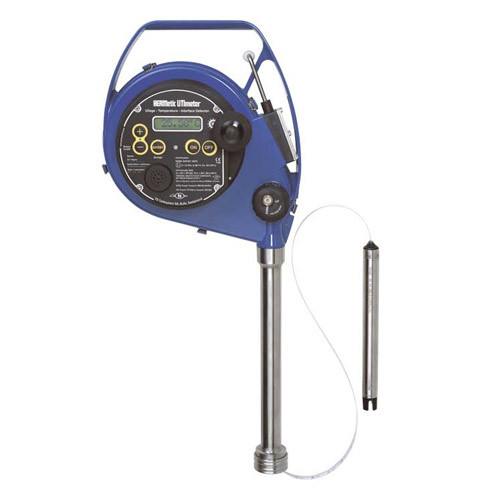
How interface detector on ships work?
The interface detector consists of two main parts : Sensor/antenna and display/control system.
Interface detectors works by measuring the difference in voltages according to the conductivity of water. The interface is detected by a sensor attached to a weight, which is lowered in the tank. By measuring the energy absorption of the fluid surrounding the sensor, the interface detector senses the emulsion regardless of density, viscosity, temperature, pressure or pH.
Interface detectors are basically a kind of conductive level sensor, which help in point level detection of conductive liquids. They use a low-voltage, current limited power source applied across different electrodes. A conductive liquid which contacts both longest and shorter probe completes a conductive circuit. The change in conductivity helps in detecting the oil/water interface.
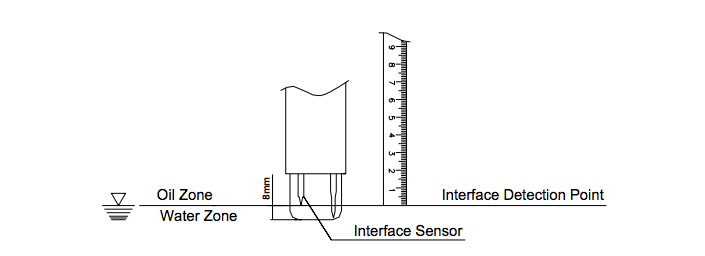
As interface detectors use low current and voltage, they are extremely safe and are made to be intrinsically safe to meet international standards for hazardous locations on ships. Safety of the ship and its crew should be the prime concern while carrying out cargo operations on tanker ships. Oil water interface detectors are thus used to ensure that the level of oil is within the safety limit so that no oil pollution happens when the water is discharged overboard from slop or ballast tanks.
Disclaimer :
The information contained in this website is for general information purposes only. While we endeavour to keep the information up to date and correct, we make no representations or warranties of any kind, express or implied, about the completeness, accuracy, reliability, suitability or availability with respect to the website or the information, products, services, or related graphics contained on the website for any purpose. Any reliance you place on such information is therefore strictly at your own risk.
In no event will we be liable for any loss or damage including without limitation, indirect or consequential loss or damage, or any loss or damage whatsoever arising from loss of data or profits arising out of, or in connection with, the use of this website.
Disclaimer :
The information contained in this website is for general information purposes only. While we endeavour to keep the information up to date and correct, we make no representations or warranties of any kind, express or implied, about the completeness, accuracy, reliability, suitability or availability with respect to the website or the information, products, services, or related graphics contained on the website for any purpose. Any reliance you place on such information is therefore strictly at your own risk.
Do you have info to share with us ? Suggest a correction

About Author
An ardent sailor and a techie, Anish Wankhede has voyaged on a number of ships as a marine engineer officer. He loves multitasking, networking, and troubleshooting. He is the one behind the unique creativity and aesthetics at Marine Insight.
Latest Marine Technology Articles You Would Like:
- 10 Harmful Effects Of Impure Air On Ship’s Machinery

- 10 Important Things to Check While Starting Fuel Oil Purifier on Ships
- 10 Noteworthy LNG-Powered Vessels
- 10 Points for Efficient Turbocharger Operation On Ships
- 10 Practical Tips to Handle Engine Room Pumps
- 10 Precautions to Take Before Operating Controllable Pitch Propeller (CPP) on Ships




Subscribe To Our Newsletters
By subscribing, you agree to our Privacy Policy and may receive occasional deal communications; you can unsubscribe anytime.
We manufacture non-contact oil-water interface detector. For more information please visit our website at http://www.abmsensor. com.