


How Are Shipping Containers Made?
Shipping containers have revolutionized the way cargo is transported on ships across oceans. Containerization has not only helped in ensuring the safety of the cargo but has also improved the overall cargo carrying capacity. As a result, shipping containers of different types are being built and used for transporting a variety of cargo around the world. (Note: Directly Skip to the Amazing Video Below to Find Out How Shipping Containers are made!)
Some of the most commonly used types of shipping containers are 20ft, 30ft, 40ft, refrigerated etc. A list of different types of shipping containers used in the market can be found here. Mostly, all shipping containers are made from steel and have closed-top with hinged doors. They have corrugated walls on the top and bottom sides and are welded to the rails and end frames.
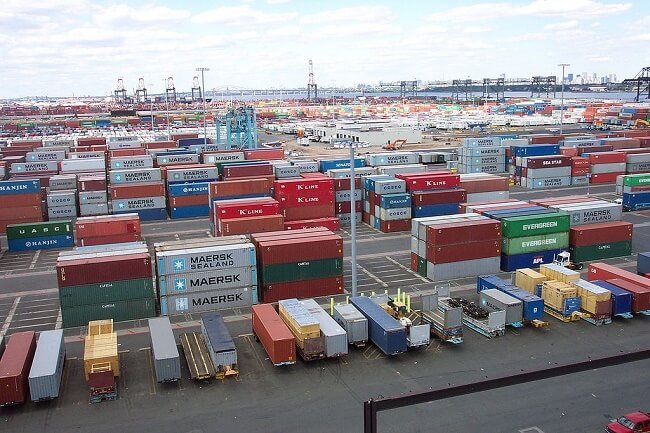
Shipping containers are constructed and used in large number on container ships. There has been a sudden rise in the demand and usage of shipping containers in the past few years. The production of these steel boxes has thus increased around the world.
How are shipping containers made?
Shipping containers are made from materials such as steel, aluminum, fibre-reinforced polymer etc or a combination of all. Construction of an ideal shipping container can be explained in an amazing video made by the Big Steel Box.
- Each shipping container starts with a big roll of steel, which is unrolled and cut into several sheets.This is done in dedicated factories with technically advanced machinery systems.
- Surface preparation of these steel sheets is then carried out using sand blasting and priming to remove rust, dirt, contaminants etc.
- The sheets are then corrugated to improve the overall strength.
- Roof panels and floor braces are separately made and sheets for wall panels are then welded together.
- Square tubing is welded on the top of the walls.
- Once this is done, floor panels are assembled to form a floor frame.
- Door assembly and corner post assembly are also separately prepared.
- The door assembly is then installed on the floor frame followed by installation of wall panels.
- The corner posts, wall panels and door assembly are welded.
- The roof panel is then assembled and welded.
- Priming and painting is carried out.
- Wooden frames are varnished and prepared for flooring.
- Once they are installed in to the container floor, holes are drilled to attach flooring panels.
- The door hardware is finally installed along with rubber seals for watertight doors.
- The container bottom is then made waterproof followed by watertightness testing.
- The box is finally inspected to ensure watertightness or any other problem.
According to Big Steel Box, a new 20′ shipping container would usually cost around $ 4000-4500. However, the cost would definitely differ depending on the location.
Today, shipping containers are not only used for cargo operations but also have a variety of other applications. Click here to find out different ways in which shipping containers are used today.
Do you know any other ways in which shipping containers are or were made? Let us know in the comments below.
Disclaimer :
The information contained in this website is for general information purposes only. While we endeavour to keep the information up to date and correct, we make no representations or warranties of any kind, express or implied, about the completeness, accuracy, reliability, suitability or availability with respect to the website or the information, products, services, or related graphics contained on the website for any purpose. Any reliance you place on such information is therefore strictly at your own risk.
In no event will we be liable for any loss or damage including without limitation, indirect or consequential loss or damage, or any loss or damage whatsoever arising from loss of data or profits arising out of, or in connection with, the use of this website.
Do you have info to share with us ? Suggest a correction
Disclaimer :
The information contained in this website is for general information purposes only. While we endeavour to keep the information up to date and correct, we make no representations or warranties of any kind, express or implied, about the completeness, accuracy, reliability, suitability or availability with respect to the website or the information, products, services, or related graphics contained on the website for any purpose. Any reliance you place on such information is therefore strictly at your own risk.
In no event will we be liable for any loss or damage including without limitation, indirect or consequential loss or damage, or any loss or damage whatsoever arising from loss of data or profits arising out of, or in connection with, the use of this website.

About Author
An ardent sailor and a techie, Anish Wankhede has voyaged on a number of ships as a marine engineer officer. He loves multitasking, networking, and troubleshooting. He is the one behind the unique creativity and aesthetics at Marine Insight.
Latest Marine Technology Articles You Would Like:


- 10 Harmful Effects Of Impure Air On Ship’s Machinery

- 10 Important Things to Check While Starting Fuel Oil Purifier on Ships
- 10 Noteworthy LNG-Powered Vessels
- 10 Points for Efficient Turbocharger Operation On Ships
- 10 Practical Tips to Handle Engine Room Pumps
- 10 Precautions to Take Before Operating Controllable Pitch Propeller (CPP) on Ships







Subscribe To Our Newsletters
By subscribing, you agree to our Privacy Policy and may receive occasional deal communications; you can unsubscribe anytime.
If you look closely while driving out and about, you’ll discover Shipping containers just about everywhere. Following long travels on the sea, you’ll observe containers in the final distribution channels. When you get stopped at the train crossing, you’re very likely to see train car after train car filled with containers, or you’ll observe commercial transport trucks carrying them around on carriages and flat beds full of goods of every type. Once shipping containers are retired from use overseas service, you’ll see them behind retail stores and on building sites supplying secure storage for equipment and inventory doing duty as storage containers.
I just watched this youtube video how this genius containers are made, thanks for linking this.
May i consider to buy some and build some great tiny container home out of it..
Thanks for sharing the video Anish..
Shipping Containers have revolutionized not just the transportation and shipping industry but now also trying to take over the construction industry with many houses, and accommodation being built from it..
Here’s an article from my blog about how Shipping Containers have become cheap housing for students in South Africa..
https://shippingandfreightresource.com/shipping-containers-become-cheap-housing-for-students/
Thanks Hariesh for sharing it with us!!
Excellent post, the shipping containers are revolutionizing several areas, not only the marine cargo but even the home! Something that was not expected or could be imagined in the last century haha.
The containers that I liked the most because of their structure and quality are those used by King Ocean (www.kingocean.com), they are truly something unique!
There are very interesting articles regarding the use that can be given to shipping containers, many things can be done if you have creativity
Hi,
This is Reena Dale. very useful post and a great video on Shipping Containers. Is there a website too where I can find more information about these containers?
Great video! Very educational. I’d love to share the link to the video.
Hi
I saw this on YouTube. I was very impressed. One of the best container concepts I came across so far.