


Heat Exchangers on Ship Explained
Heat exchanger is an equipment which reduces the temperature of a medium by transferring temperature of that medium to another, when both the mediums are separated by a solid membrane or wall like structure. For efficient operation, the surface area of the wall which separates the two mediums is maximized, simultaneously minimizing the flow resistance of the fluid.
Exchanging of heat in a heat exchanger can be in between- liquid and liquid, gas and liquid, liquid and gas etc. For heat transfer basically three patterns of flow are used for construction of a heat exchanger.
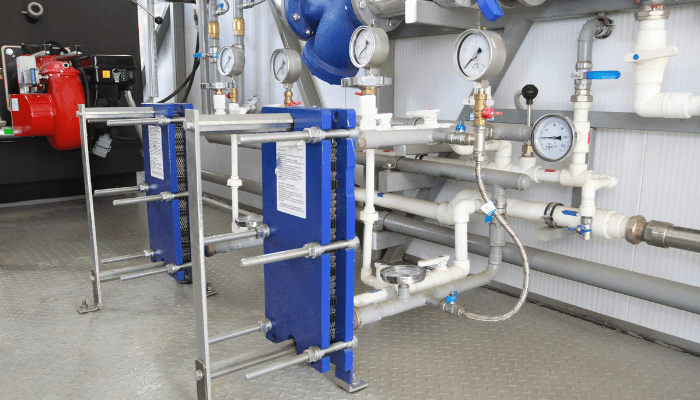
Opposite Flow : Primary medium (to be cooled) and secondary medium (which is cooling the primary medium) enters in the heat exchanger in the opposite direction to each other.
Cross flow : Primary and secondary medium enters in an exchanger perpendicular to each other.
Parallel flow : Primary and secondary medium both enter the heat exchanger parallel to each other.
Where are Heat Exchangers Used Onboard Ship?
Each and every system in a ship is interlinked with each other in some way or the other. Even if one system fails, vessel can come to a standstill.
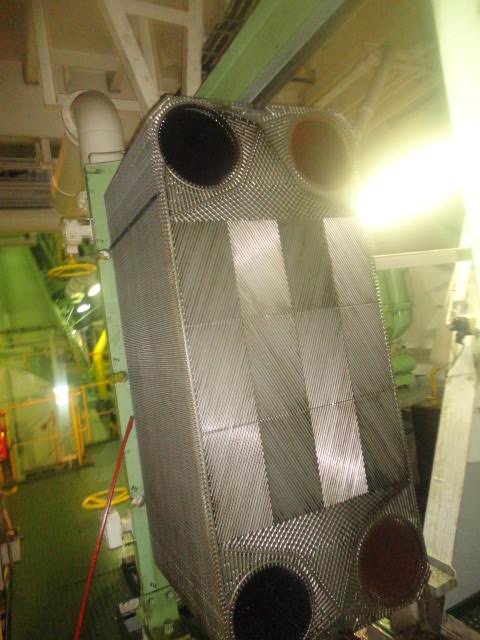
Heat exchanger plays an important role for efficient working of different systems, which include-
1) Propulsion Plant:
– Main propulsion plant consists of different sub system for running of main engine like lube oil system, jacket water system (open or closed system), fuel system etc.
– While generating energy all these systems gets heated up and the temperatures are controlled by the use of heat exchanger in the system.
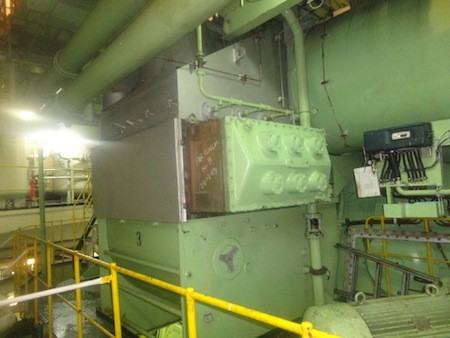
– Heat exchangers normally used in main propulsion system are – Shell and tube type and plate type heat exchanger.
2) Auxiliary Power Generation System:
– Auxiliary power generation system is similar to the main propulsion system, except that the power is generated in terms of output.
– Shell and tube type, plate type and plate fin type heat exchanger are generally used
3) Starting Air System:
– High pressure air is produced in the compressor which is further cooled in inter-cooler, which acts as a heat exchanger
– Shell and tube type exchanger is popularly used for this purpose.
4) Fuel injection system:
– For proper atomization, fuel is heated up in a heater with heating medium as steam. Shell and tube type heater is used for this purpose.
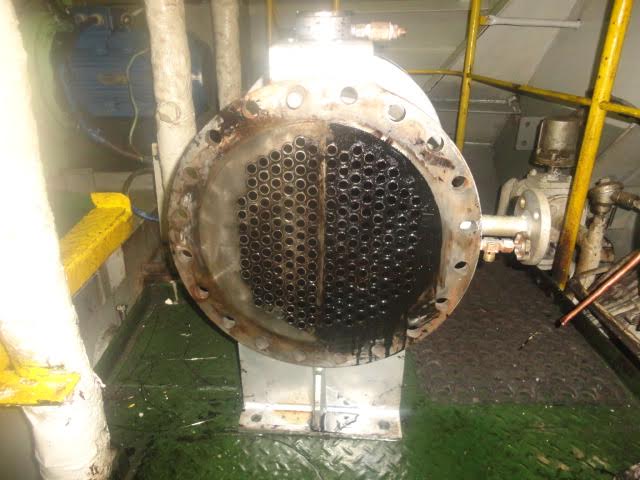
– For reducing Sox emission from propulsion plant, combustible fuel is mixed with a spray of water, for this direct contact heat exchanger is used.
5) Refrigeration System:
– In refrigeration system, for meat room, fish room and vegetable room, evaporator acts as phase change heat exchanger.
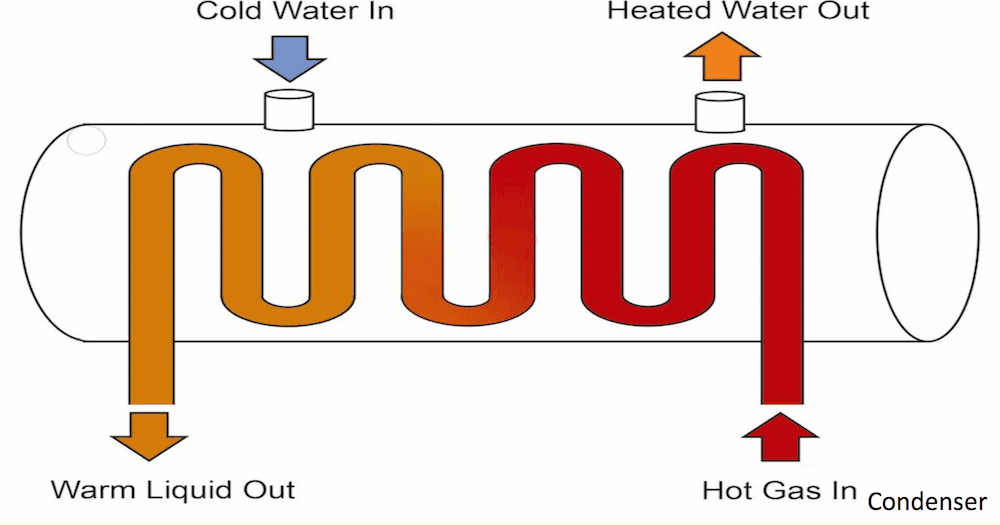
– Shell and tube type unit is used for condenser unit in refrigeration system.
6) A.C system:
– For maintaining the temperature, phase change heat exchanger unit is installed as evaporator.
– Condenser unit is normally shell and tube type exchanger.
– For generating fresh water, sea water condenser and jacket water evaporator is used. Both are types of heat exchangers.
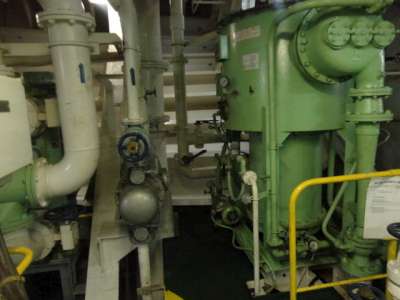
– Shell and tube type and plate type heat exchangers are normally used for this.
8) Steam Turbine Unit:
– If a ship consists of a steam turbine or turbine generator, normally spiral heat exchanger is used for heat transfer.
Apart from the above mentioned places, there are several other applications where heat exchangers are effectively used for the smooth running of the ship.
If you liked this article, you may also like to read Types of heat exchanger in ship.
Disclaimer :
The information contained in this website is for general information purposes only. While we endeavour to keep the information up to date and correct, we make no representations or warranties of any kind, express or implied, about the completeness, accuracy, reliability, suitability or availability with respect to the website or the information, products, services, or related graphics contained on the website for any purpose. Any reliance you place on such information is therefore strictly at your own risk.
In no event will we be liable for any loss or damage including without limitation, indirect or consequential loss or damage, or any loss or damage whatsoever arising from loss of data or profits arising out of, or in connection with, the use of this website.
Do you have info to share with us ? Suggest a correction
Disclaimer :
The information contained in this website is for general information purposes only. While we endeavour to keep the information up to date and correct, we make no representations or warranties of any kind, express or implied, about the completeness, accuracy, reliability, suitability or availability with respect to the website or the information, products, services, or related graphics contained on the website for any purpose. Any reliance you place on such information is therefore strictly at your own risk.
In no event will we be liable for any loss or damage including without limitation, indirect or consequential loss or damage, or any loss or damage whatsoever arising from loss of data or profits arising out of, or in connection with, the use of this website.
Latest Marine Technology Articles You Would Like:

- 10 Harmful Effects Of Impure Air On Ship’s Machinery

- 10 Important Things to Check While Starting Fuel Oil Purifier on Ships
- 10 Noteworthy LNG-Powered Vessels
- 10 Points for Efficient Turbocharger Operation On Ships
- 10 Practical Tips to Handle Engine Room Pumps
- 10 Precautions to Take Before Operating Controllable Pitch Propeller (CPP) on Ships




Subscribe To Our Newsletters
By subscribing, you agree to our Privacy Policy and may receive occasional deal communications; you can unsubscribe anytime.
This website is very helpful for students.
I really appropriate your effort of bring vital information on marine engineering other areas.thanks more kudos.
There is a spelling mistake,
8. Steam Turbine Unit
If a ship consists of “stem” turbine ….
Thank You Aman for the pointer.