


The Ultimate Guide to Dry Docks: Types, Functions, and Essential Requirements
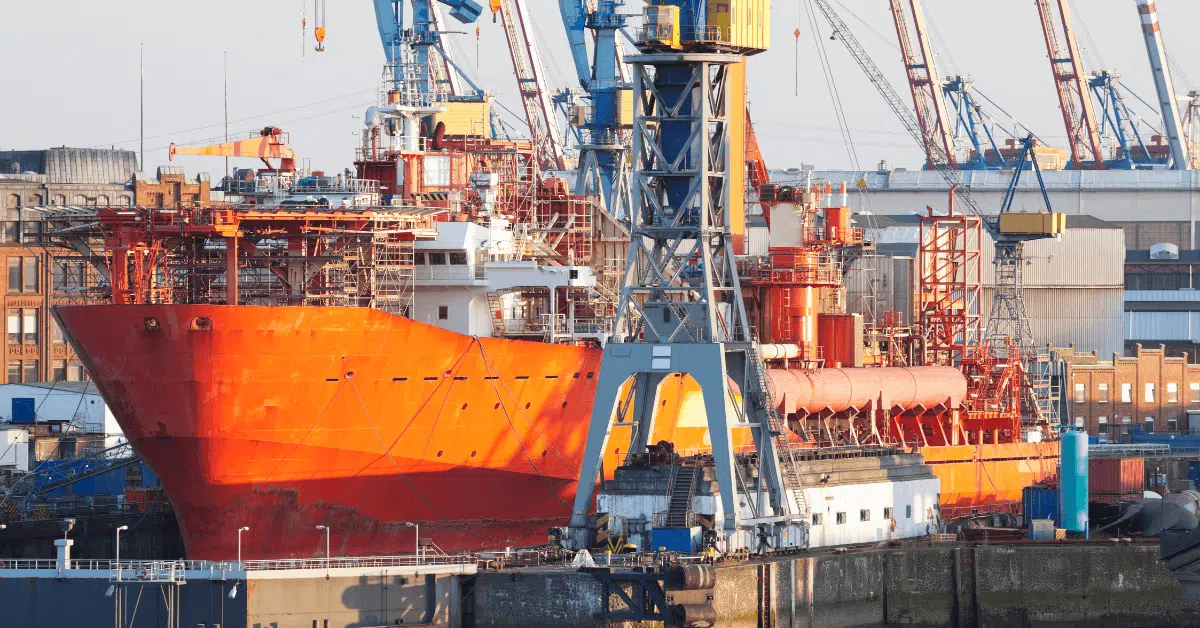
A dry dock is a structured area where the construction, repairs, and maintenance of merchant vessels and boats are carried out. This unique construction or arrangement allows water to be filled up in an area, also known as a lock, so vessels can be manoeuvred in and out of the area.
Once the vessel enters the dry dock, the gates are closed, and the seawater is drained out so that the hull and other parts of the ship, which have been exposed to seawater for a long time, are exposed for maintenance and repair work.
Dry Dock Survey
As per SOLAS requirements, all Merchant vessels require a complete survey of the hull in a dry dock twice within a 5-year period and an intermediate survey within 36 months at the earliest.
This includes maintenance of the hull, propeller, rudder, etc. and other parts which are immersed in water and are generally inaccessible by staff when the ship is sailing
For a passenger vessel, the bottom is to be inspected annually. Two such inspections in a period of five years must be carried out in dry dock, and the maximum interval between these inspections should be three years.
Types of Dry Dock
Different types of dry docks are used for repairing and cleaning a ship. The main ones are:
- Graving dock
- Floating dock
- Marine Rail Dock
- Shiplifts
- Marine mobile lifts
Among these, the marine mobile lifts and ship lifts are mainly used for small vessels such as recreational yachts, tugs, pilot boats, etc.
Nowadays, there are mainly two types of dry dock procedures from the above list that are used for seagoing vessels:
1) Graving Dry Dock
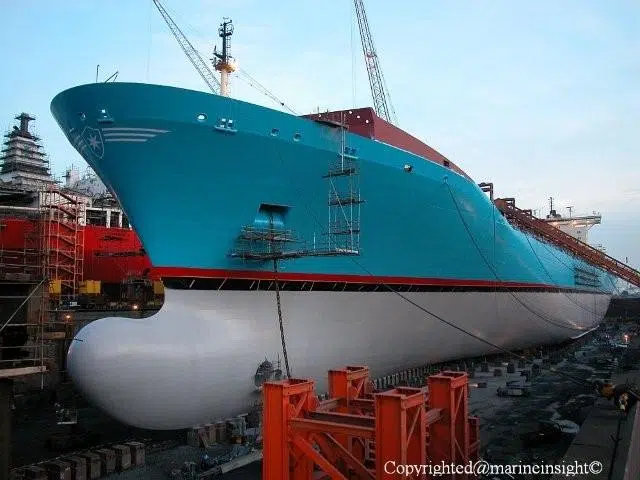
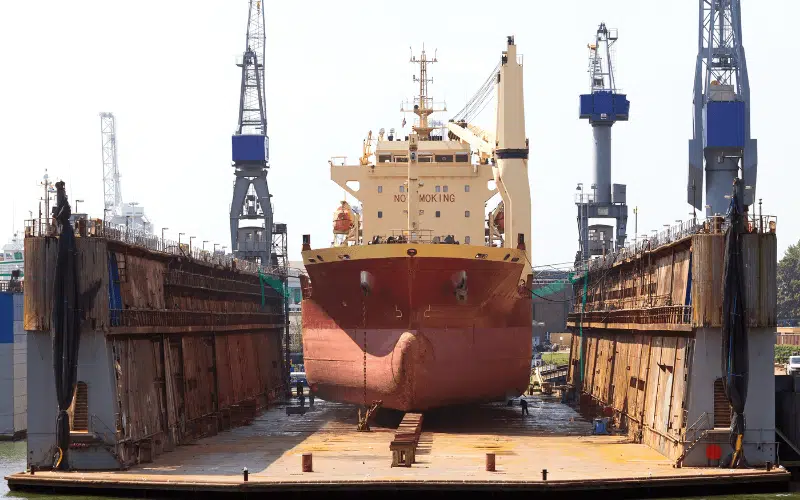
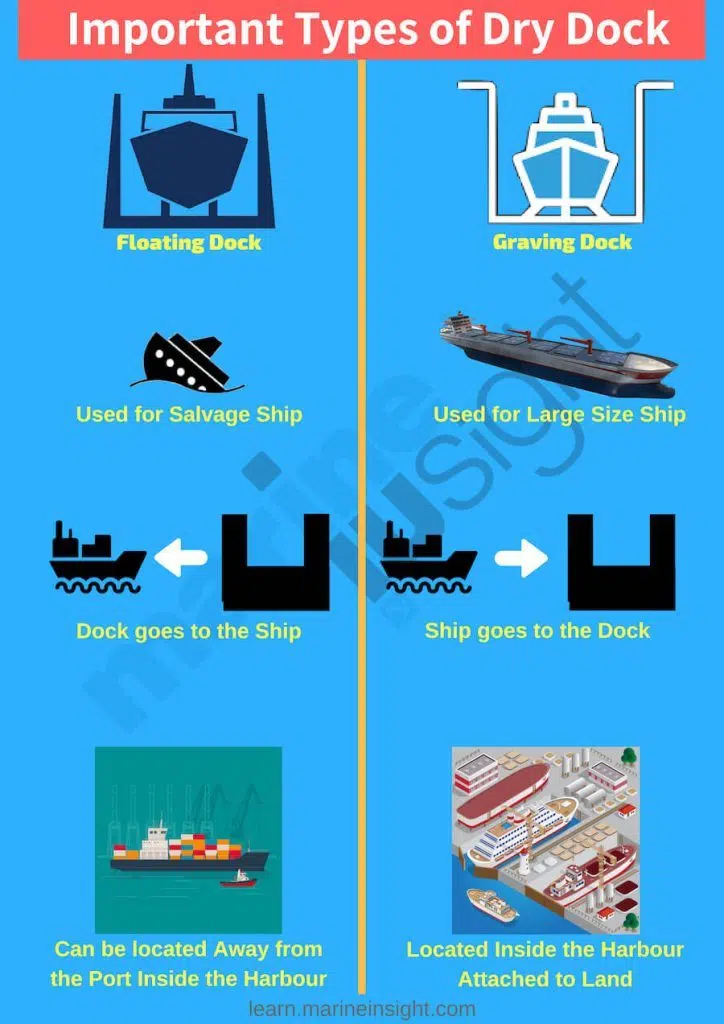
This type of dry dock is normally constructed on land near coastal waters. It is rectangular and made of solid concrete, with blocks, walls, and gates. The vessel is shifted inside the dry dock and rested on the blocks. After the ship is in the required position, the gate is closed, and water is removed.
Related Read: Understanding Ship Stability During Dry Dock
In the past, the graving dry docks were constructed using stones and timber. Now, a steel and concrete enclosure is used, and a heavy steel gate is used to seal the dock to stop water ingress once the ship is standing on the blocks.
The gates can be in two parts, with each hinged to the sides and hydraulically operated, or one solid steel structure supported on a roller over the track, which can be retracted inside the dry dock walls when opening the gate.
Advantages of Graving Dry Dock
- It can accommodate vessels of bigger sizes when compared to other dry docking systems.
- It is cheaper to dry-docking a vessel of a similar size to other types.
- The graving dry dock can perform retrofitting, modification, etc., which is challenging in other types.
- Due to its location near the land, the graving dock is easily accessible for the supply of spares, machinery, and services.
- New advanced graving docks have welding, hot-work and other workshops inside the dock on an elevated surface (above the water surface when the dock is filled), giving quick access and workflow in the dock.
- Retractable ramps in new graving docks make it easy to supply spare machinery and save a lot of time and manpower to transfer them inside the dock.
- A bigger graving dock can be used to repair more than two ships at a time, and some modern graving docks have two gates at both ends, making it easier to repair and re-float the vessel independently.
Disadvantages of Graving Dry Dock
- When re-flooding the dry dock, all the machinery and equipment needs to be taken out from the dock, which takes time.
- The maintenance cost of the graving dock increases as per the age of the dock and becomes very high.
- Any problem with the dock gate will make the whole dock non-operational
- The docking and undocking process in the graving dock takes time compared to other types
- If the dock holds multiple ships for repair, the complete operation needs to be stopped if any one of the vessels needs to be taken out of the dry dock as it will require filling of water for refloating
2) Floating Dry Dock
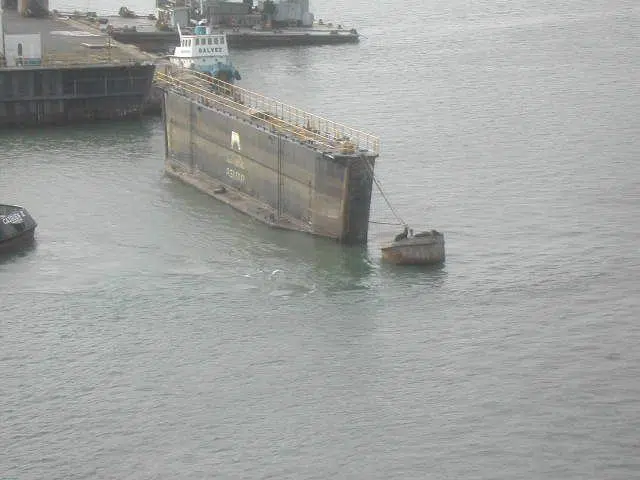
A floating dock is in the form of a “U” structure, mainly used in salvage to carry ships that have met with an accident and are damaged to an extent that has made them unable to sail further to a coastal dock.
However, many regular sea-going, small, and mid-size vessels are now dry docking in floating docks. Several “U” type floating docks can be joined to carry a large vessel.
The ship is brought near the channel where the floating dry dock will partly submerge itself, and the ship slides inside the dock.
Once the ship is in position, the floating dock is de-ballasted to drain the water from its hollow floors and walls, which support the vessel on the blocks arranged on the dock’s floor.
A valve is provided that can be opened to fill up the chambers with water and immerse the dock so that the ship can sail out.
The water is pumped out of the chamber, allowing the dry dock to rise, exposing the underwater area of the ship for maintenance or carrying out the ship repairs.
Related Read: What is Ballasting and De-ballasting?
The floating dry dock is usually built using steel framing similar to that of seagoing vessels, with ballast tanks provided on the sides and bottom to raise and lower the dock.
Floating dry docks are commonly operated in sheltered harbours, where there are no waves or natural tidal activities.
Advantages of a Floating Dry Dock
- They can be propelled to the location of a salvage vessel near the harbour
- They are cheaper to maintain as compared to graving docks and can get a higher resalable return
- They can be installed near or away from the shore inside the harbour, making them a portable and space-saving structure without taking space of the shore facility
- The complete floating dry dock can be aft or forward trim by ballasting the dock, which further assists the ship or the damaged vessel which cannot be given a trim
- Additional mooring equipment is needed for the floating dry dock to make it stable
- The floating dry dock can be altered and increased in size in all dimensions by extensive retrofitting/ rebuilding
- They can also be split into two different floating docks independent of each other

Disadvantages of Floating Dock
- The supply of store, equipment, and manpower is usually done from one access point gangway, which makes the operation slow.
- The maintenance cost of a floating dry dock is similar to that of a ship, as the hull is submerged in saltwater.
- The floating dry dock operation will be affected if there are tides or during windy weather.
- When re-flooding the dock, all the machinery and equipment needs are to be removed, which takes time.
Blocks Of Dry Dock
The blocks inside the dry dock play a critical role in taking the ship’s load and distributing it among the blocks placed below the keel plates. Every ship has a docking manual that will provide a guide block plan approved by the Ship Classification Society.
The shipmaster/ chief officer and the dry dock master must understand the blocking plan for the particular vessel and how the ship will behave under load when resting on the blocks, including various factors that can affect the load a block takes.
The blocks are usually constructed from one material so that their stiffness is similar. If the blocks are built from different materials, the force exerted on the blocks with a smaller elasticity module will squeeze them more than the stiffer block. This can lead to damage to the block or the ship’s hull, as the force distribution will be uneven.
The most common materials used for the blocks are:
- Concrete with steel
- Timber blocks
- Timber on top and concrete at the bottom
When a timber block is added to a keel track built of blocks with concrete or steel bases, the timber block will take a much smaller load than the others.
Apart from the keel blocks, side blocks are also arranged to support the ship. They are less stiffer than the keel blocks as a stiffer side block will overload the vessel and may damage the structure. The height of the slide blocks is usually similar or more than that of the keel blocks.
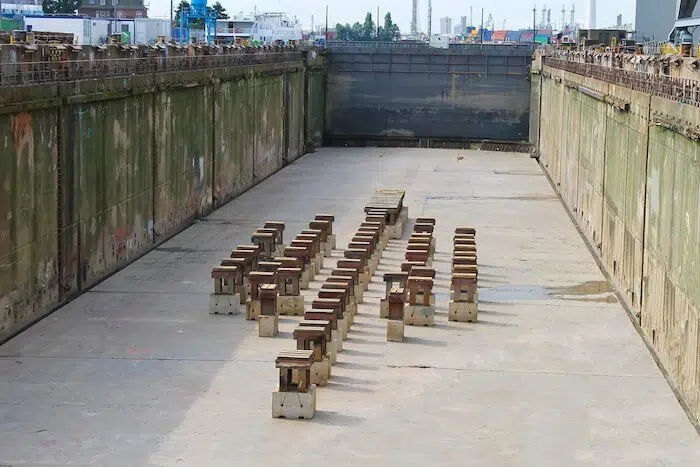
Important factors which affect the loading on the dry docking blocks are:
- The initial height of the block: The block’s height is a critical factor, as the load on the individual block will be determined by the load shared by all the other blocks. If the placement and height of the blocks are according to the ship’s hull, the load distribution will be even.
- The contact area of the block: The contact area of the block with the ship’s hull determines the load distributed on the block. If the contact area of the block is smaller in size, this means the load exerted on this block will be lesser than that with a larger contact area.
- The material of the block: As stated earlier, different materials will react differently to the load exerted by the ship. Hence, the material of the block used for the keel block and the side block plays an important role in aligning the ship in the dry dock.
- Placement of the block: The blocks in the dry dock need to be arranged according to the ship’s docking plan. Many types of equipment and parts can get damaged if the block position is not altered. For example, echo sounders, anodes, etc., the blocks need to be removed so that these equipment tools have space to settle once the ship rests on them.
Choosing A Type of Dry Dock
The criteria to select a type of dry dock for a ship depends on the following factors:
- The size of the vessel: The graving dock accommodates larger sizes than any other type. If the shipowner/ manager has to dry dock a large oil tanker, they will go to the graving dock. The Marine railway type can be used if the vessel is about 10000 tonnes. If a boat or small yacht of up to 250 tonnes needs repair in the dock, a mobile marine lift can be used.
- The condition of the vessel: If the vessel propulsion plant is not working or some damages can make a ship immobilized, floating docks are commonly used in such a condition
- Types of repair: The choice of dry dock type also depends on the type of repair the ship wants to undergo. For the regular scheduled dry dock, a floating dock can be selected; however, if there is major retrofitting or massive parts/ machine fitting is required, the graving dock is chosen as they are usually located near the shipyard and it is easy to move the material from land to dock as compare to the floating dock.
- Schedule of the Vessel: The location and the type of the dry dock will be decided as per the current schedule of the vessel and how easy it is for the ship to reach the dock after unloading all the cargo to the last port of call
- Budget: The most critical factor in selecting the type of dry dock is the budget allotted to the ship
Related Read: How Cost Estimation is done for Ship’s Dry Dock?
Requirements for Dry Docking
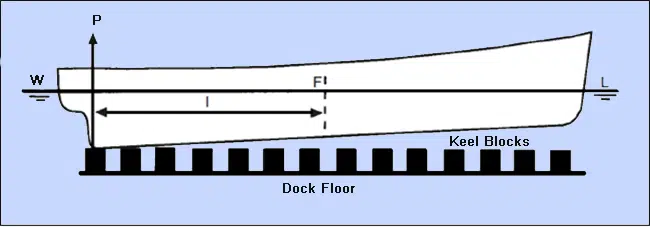
Stability is the most important requirement for getting a ship safely into a dry dock. The three important parameters which must be ensured before entering the dry dock are:
1) Adequate Initial GM:
When the ship touches the blocks, a reaction at the point of contact raises the centre of gravity “G” and reduces the metacentric height “G.M.” so that an adequate initial metacentric height is required to compensate for this.
2) Vessel to be Upright:
While entering the dock, the vessel must be upright, meaning there should be no port or starboard list when the ship touches the blocks. If the point of contact of the ship and keel blocks is outside the centre line of a vessel, it may force the ship to tip over.
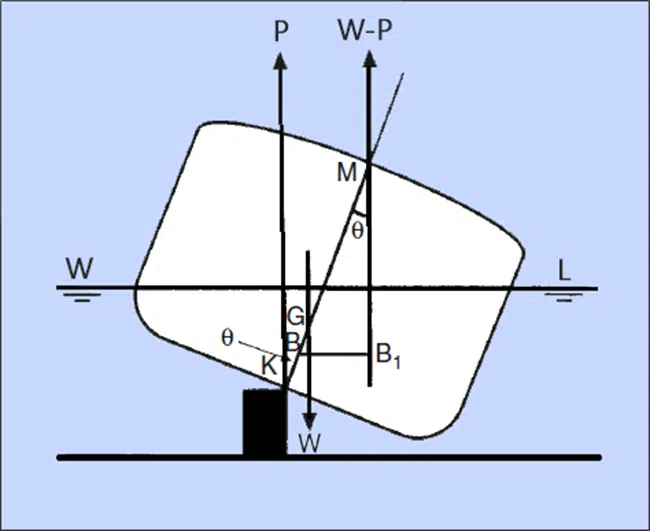
3) Small or Moderate Trim Aft:
When making the ship’s keel sit on the keel block, a moderate trim aft is usually kept. As the water level in the dock lowers, the slight trim allows the stern and bow to ascend in tandem rather than simultaneously, which will reduce the load and pressure on a vessel’s hull and keel.
Related Read: 10 Types of Dry Dock Accidents That Can Occur in Ship’s Engine Room
Dry Dock Procedure
Once the ship manager selects the type of dry dock, the next step is to prepare the ship to enter the dry dock and carefully place the ship’s keel on the blocks provided on the dry dock floor. Some important points to note are:
- Make sure the ship is prepared to enter the dry dock by having the least ballast and no cargo carried on board
- If the floating dock is used, the ship’s movement will depend on the docking master’s requirements and the vessel’s condition. If the vessel is immobilized due to an accident, the floating dock will move towards it, and if the vessel is functioning correctly, it may propel inside the dock.
- Once the ship enters the dry dock, it is moored to the dock
- The docking master will inform the ship’s crew beforehand about the trim requirement they must maintain.
- Before emptying the dock, the ship and dock master must ensure that equipment like an echo-sounder or log sensor does not hit any blocks and is clear of any obstruction. For this, divers are sent to check that all such equipment is precise of the blocks
- The dock master will give the order to pump the water out from the dock, and slowly, the ship will sit on the keel blocks
- The docking master and the ship’s crew must ensure the point of contact of the ship and keel blocks does not lie outside the centre line of a vessel as it may lead to the tumbling of the ship
- Once the ship sits on the dock, the cleaning and repairing process starts
Related Read: Dry Docking of Ships – Understanding Stability And Docking Plan
Duties of Ship Crew Members During Dry Docking
While dry-docking the ship, the duty of the ship’s crew (under the guidance of the chief engineer and chief officer) will be:
- To keep the ship at minimum ballast condition
- To keep the aft trim as requested by the dockmaster
- To ensure the vessel is moored by assisting the dock crew once the ship comes inside the dry dock
- To keep a check on the stability of the ship while the water is lowered in the dock
- Once the ship is sitting on the blocks, the ship’s crew will pump out the ballast
- To prepare the vessel to connect to the shore power
- Once the dry dock water is pumped out, de-ballast tanks using gravity
- Remove the drain plugs from the bottom of the ship for various tanks
Related Read:
Drydocking is one operation that allows the ship’s crew to learn areas that cannot be explored when the ship is sailing.
It also helps the ship manager to assess the condition of the ship’s hull and the machinery which are not accessible when the ship is in water.
Bringing the ship to the dry dock is a team effort between the ship’s crew and dry dock personnel. Proper communication is the key to safely laying the ship’s keel on the keel blocks.
Disclaimer: The authors’ views expressed in this article do not necessarily reflect the views of Marine Insight. Data and charts, if used, in the article have been sourced from available information and have not been authenticated by any statutory authority. The author and Marine Insight do not claim it to be accurate nor accept any responsibility for the same. The views constitute only the opinions and do not constitute any guidelines or recommendation on any course of action to be followed by the reader.
The article or images cannot be reproduced, copied, shared or used in any form without the permission of the author and Marine Insight.

About Author
Raunek Kantharia is a marine engineer turned maritime writer and entrepreneur. After a brief stint at the sea, he founded Marine Insight in 2010. Apart from managing Marine Insight, he also writes for a number of maritime magazines and websites.
Do you have info to share with us ? Suggest a correction
Latest Shipboard Guidelines Articles You Would Like:



Subscribe To Our Newsletters
By subscribing, you agree to our Privacy Policy and may receive occasional deal communications; you can unsubscribe anytime.
Dear sir
We have ship repair yard and we are trying to build a graving dock of 121 metres length in to in 21metres in to in breath
What are the basic standard ofvsafety required and what is the minimum thickness of concrete walls required finally will a dept of 3.5 mettres be enough to dock a vessel of 8 metres draft. In balance
Thanks in antipation
Hi Issah,
Personal take on building a graving dock should come from a commercial stand point, then design according to your commercial needs, the soil condition and sea bed conditions of graving dock location.
Based on the size according to your input, my guess on your target segment are tugboats, small fishing trawlers and maybe catamaran. Look at your total geographic location and see if there are expanding business opportunities such as offshore OSV potential, OSV support base and such. Otherwise it will be costly to rebuild or modify your graving dock again just to cater for missed opportunities. Similarly there is always a question of cost when how big a size is enough? The very reason why I feel your commercial requirements rules over what size of docks to build. Generally I feel your dock should cater at least 20 years of business projection.
On the size that you mentioned, seems like this project of yours is very initial stage and you are currently working on minimum information. Your depth of graving dock should not be determined by whether you can take certain vessel draft. Instead do your seismic on the sea bed and understand what are your tide movements. I have seen shipyards building docks with more depths but needs dredging periodically more than required. I have bring vessels in on 7.5 mtrs draft although the docking draft at zero tide is 5.5 mtrs, simply because I worked on high tide window of 2 to 3 mtrs.
To me ship repair is exciting and to an extend fun because it really challenges your thinking outside the norm. Keep looking and keep understanding your area, ship repair is not just the repairs per said. You can have the best and safes dock, world class facilities and effective workforce. If the ship cannot come, is effort down the drain.
Good luck and all the best.
Regards
Clement See
What are the dry dock repairs under statutory / class requirements
List any three jobs usually done on the anchoring system of a ship in a dry-dock .?
Hello, I’m trying to put together a proposal for the construction of a floating dock. Is there anyway to deduce and estimate for the construction of breakwater, with a total length of 1500m.
Good Day All,
How much power is required, on average, per dock, for a typical dry dock system
Regards
Please send me a buchture of Dry Dock
A Korean shipyard named Hanjin Heavy Industries is considered one of the biggest shipyard in Asia where there shipyard is located in Subic, Philippines (Former US naval base) .
Last month, a bad news came out that the shipyard is to shutdown and requested to the bank lenders to apply for bunctiotcy.
There are about more than 2,000 employees to be displaced. In this regards, we would like to invite any investors to save more than 2,000 employees being laid off due to mismanage of the company.
If anyone would interested to take over the shipyard. Please feel free to contact me as we have hundreds of qualified welders, naval architects to support the business.
Thanks for explaining the different types of dry docks and that you mention how it’s important to consider the current schedule of the vessel to find one that is easy to reach so the ship can be unloaded. When choosing, it would probably help to hire a local company that offers dock construction services. This would be useful to figure out the best type based on your ship, schedule, and location and could also help you get quality materials that will work properly and last a long time.
How does ECDIS System affected, when a ship is already on the blocks at Dry Dock ?
Hello
What is the maximum recommended duration of a floating dock to operate in salty water before it can undergo a major maintenance before it can continue holding vessels under dry dock.
Kind Regards
Kevin
sir. we have planed to make a prototype of graving dock which having flap gate for our project. can you tell me any specified area we should follow. Thank you.
Dear all,
Please see below which could be added to this article.
The world’s first road-transportable floating dry dock
tugdock.com