

10 Types of Maritime Crimes

International shipping and sea travel is dependent on the safety of the high seas and a network of ports and terminals. However, maritime crimes have become a major concern as they threaten the safety and security of ships and seafarers and the entire maritime industry economically.

Though maritime crime is as old as the industry itself and has evolved, its implications remain the same i.e. a loss of life and property. Since the high seas do not come under the jurisdiction of a particular state, global cooperation is vital for handling maritime crimes like piracy to protect ships from becoming the targets of organised transnational criminal groups that take crew members as hostages, demanding a hefty ransom in return for freeing the vessel.

Maritime Piracy is just one category of a crime at sea and there are many others which will be discussed in this article.

However, before categorising the different types of maritime crimes, let us define what a maritime crime is.

Maritime Crimes

What is a Maritime Crime?

The term maritime crime is used to describe a variety of criminal offences which are committed at sea or maritime zones like international waters, territorial sea and archipelagic waters and a country’s Exclusive Economic Zones.

These maritime crimes are of different natures such as maritime piracy, armed robbery at sea, illegal, unregulated and unreported fishing, ocean dumping, illicit trafficking, smuggling, maritime terrorism and many more.

It is important to remember that there is no boundary between what happens on sea or land since a maritime crime can begin at sea and continue on land. For eg-fish caught illegally is sold at markets on land or humans trafficked via seas are then sold into bonded labour at certain places though it is a serious crime.

Implications of Maritime Crimes

Crimes committed at sea have serious consequences and can prove to be more dangerous since there is no single judicial authority and it can take days or months to save the vessels or seafarers due to the complex legal processes that need to be followed.

Marine crimes threaten the safety and security of nations whose communities depend on marine resources for their livelihood. However, marine crimes have a far-reaching impact that is global. For example, smuggling of drugs and human trafficking.

Maritime Crimes greatly impact developing nations. It can destabilise the operations of their economy and governments. Analysing and studying the maritime crime hotspots in the world, like Somalia in the case of maritime piracy, is crucial for devising practical and realistic strategies for eradicating the crime from its roots.

Different Types of Maritime Crimes

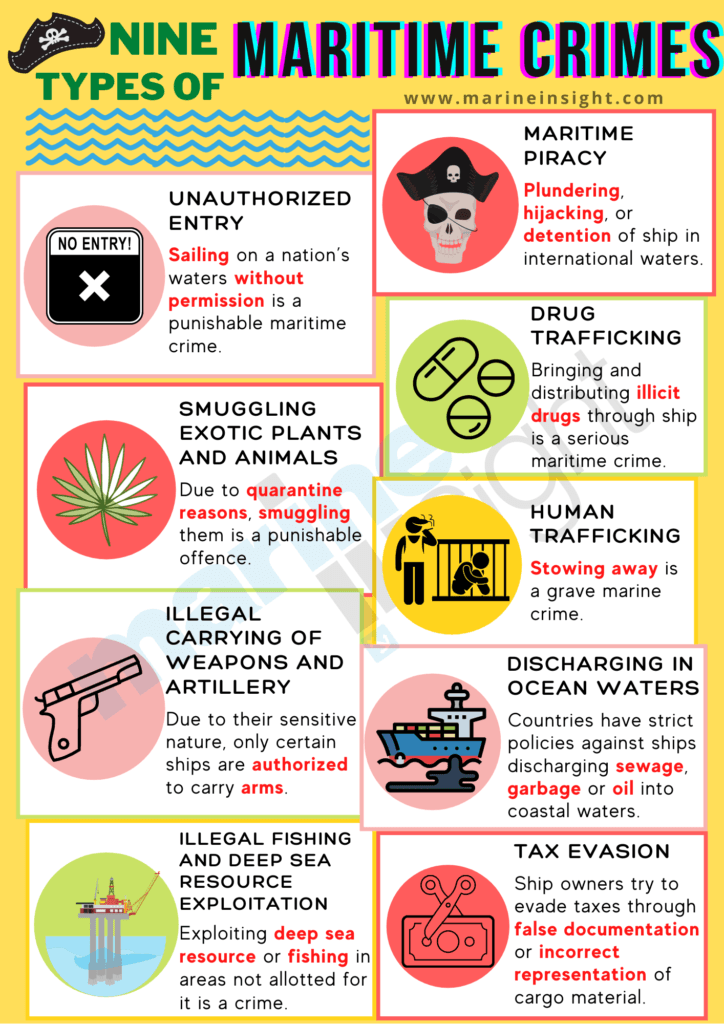
1. Piracy, Ship Hijacking, Kidnappings & Armed Robbery

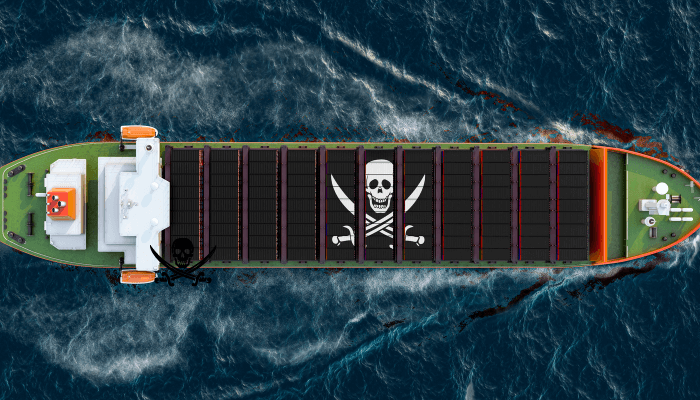
Maritime Piracy involves attacks on ships for theft, kidnapping or hijacking, which often takes place in international waters, usually when the ship is anchored, transiting a narrow waterway or going at slow speed. 

Piracy and armed robberies can lead to violence and cruelty to seafarers and even loss of life in some cases. Crew members held hostage by pirates not only experience physical pain but also mental trauma. 

Pirates commit armed robbery on ships by forcefully boarding or stealing ships and holding cargo and crew members for ransom. Though piracy seemed to decline, it has risen its head again during the COVID-19 pandemic. Maritime piracy incidents are increasing since ships alter their courses due to the Houthi attacks on Red Sea Shipping and take the longer route around Africa. 

Maritime Piracy is prevalent in Southeast Asian waters, the Horn of Africa, the Caribbean and the Gulf of Guinea, especially the Strait of Malacca, off the coast of Somalia, the Sulu and Celeb Seas and the Singapore Straits.

About 79 incidents of piracy and armed robbery were reported to the IMB Piracy Centre between January- September 2024, in which 2 ships were boarded, 9 were attempted attacks, 6 ships were hijacked and 2 were fired upon. 111 crew members were held hostage, 11 kidnapped and 3 threatened.

The root cause of piracy, especially in Africa is poverty which needs to be addressed to solve this issue at a global level. 

Maritime crimes

2. Drug Trafficking

In the list of maritime crimes, drug trafficking comes up as one of the most widespread criminal activities. Gangs and other organisations operate on the open seas which use vessels to transport illicit drugs through waterways to different countries around the globe. This is a massive industry that is controlled by mafias, valued at $400 billion per year. 

Cocaine, cannabis and opium are the most trafficked drugs. Drug trafficking hotspots known for the involvement of fishing vessels in this illegal trade include the Caribbean region, North Atlantic and Southeast Asia. Drugs using sea routes often end up in countries including Maldives, Sri Lanka, China, Europe and America.

3. Human Trafficking

This involves the exploitation of men, women and even children for many purposes, the main being forced labour and sexual exploitation. Poor people and those from countries going through civil wars or political upheavals can become targets of human trafficking gangs.

The Counter Trafficking Data Collective (CTDC) of the International Organization for Migration is the only organisation that has published data on trafficking, taken from counter-trafficking organisations from across the globe.

Per reports, in 2020 the number of victims trafficked around the world declined for the first time in two decades as the Covid pandemic restricted movement. Also, the number of victims of sexual exploitation decreased by 24% during the COVID-19 pandemic as public venues were closed where such activities usually take place. It could also be because such activities moved to hidden places, making it difficult to detect and record.

4. Illegal, Unreported, and Unregulated Fishing (IUU Fishing)

IUU fishing is conducted by ships that operate without proper licences and violate national and international regulations regarding fishing. It occurs across maritime zones, both in international waters and within national jurisdictions, leading to overfishing, depletion of marine ecosystems and threatening food security. 

Per the Food and Agriculture Organization (FAO), around 26 million tonnes of fish are illegally caught in the world, which accounts for over 15% of global fishing. Nearly 30% of illegally caught fish comes from overfishing which threatens the fish populations and the livelihood of traditional coastal communities.

5. Unauthorised Entry

If a ship has to enter another country’s maritime border, the vessel must have permission from the government of that country. Sailing in the nation’s waters without permission is a crime and is punishable in all nations. Criminal groups might use this for their benefit and target a vulnerable ship while navigating their way to a destination or while anchored at sea.

6. Marine Pollution

Marine pollution involves the dumping of pollutants, waste and oil by ships into the sea. It is a serious maritime crime which causes ecological damage, and economic loss and impacts human health. 

Marine pollution is of various kinds such as oil pollution, plastic and solid waste pollution, pollution from toxic waste, pollution due to ballast water and introduction of invasive species to new environments and sewage and nutrient pollution.

A few international conventions and regulations to deal with marine pollution include MARPOL, the London Convention, the Basel Convention and UNCLOS.

7. Smuggling of Arms and Weapons

Smuggling weapons in ships is a serious crime that involves illegal transportation of firearms, explosives and ammunition via commercial and private ships. This threatens international security, and peace and poses risks for safety and governance, especially in regions experiencing civil wars, terrorism or political upheavals.

A few hotspots of smuggling include the Horn of Africa, South and Southeast Asia, Eastern Mediterranean and North Africa, the Caribbean and Central America.

A few international conventions designed to combat smuggling include the United Nations Arms Trade Treaty, UN Security Council Resolutions etc.

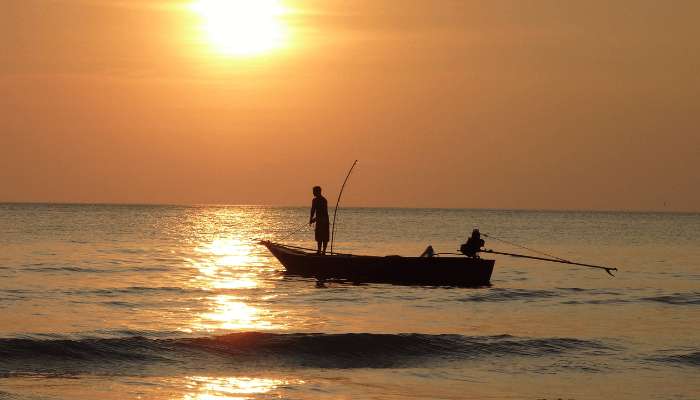
Sailing or fishing in unauthorized areas

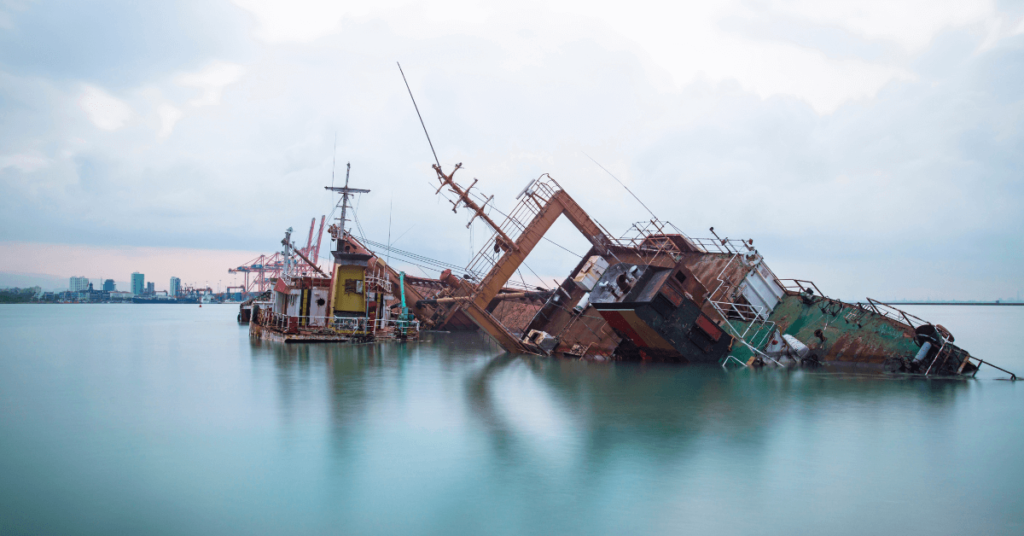
8. Illegal Salvage Operations

Illegal salvage means recovering wrecked ships or valuable materials from the sea without proper legal rights or coordination with the authorities. These actions violate laws regarding environmental protection, maritime safety and property.

Laws about salvage require salvors to obtain permission from the flag state of the shipwreck and also affected parties like insurers, owners or authorities but in illegal operations, individuals or criminal groups exploit shipwrecks without permission using unlicensed ships and equipment using risky methods.

9. Tax evasion

Cases of ship owners trying to evade taxes through false documentation or incorrect representation of cargo material have been increasing rapidly, posing a threat to maritime security.

10. Stowaways

Stowaways are individuals who board a ship without the consent or knowledge of the ship’s captain and crew i.e. illegally. They often hide on the ship, to prevent being discovered so they can travel to another country illegally. While they break immigration laws, they are not exploited as in the case of human trafficking. 

Nonetheless, they pose safety risks, often hiding in dangerous places like cargo holds, on tops of containers or in concealed places. They often undertake such arduous journeys to escape from the harsh conditions in their home country which might be witnessing a war, conflict or political upheaval. Hence, they try to go to another country to have a chance at a better life.

Ways to Improve Maritime Security

The above-mentioned crimes pose a threat to maritime security. Despite all the efforts, maritime security gets compromised when the crimes can take a dangerous turn. The lack of a coherent system and a lack of cooperation between countries is a reason why these crimes still look the marine industry in the face. Some ways through which marine crimes can be combated include:

  • Better surveillance and international cooperation
  • Use of satellite tracking
  • Tighter norms and regulations
  • More efficient monitoring of ships and ports
  • Better quarantine services

It is important that countries realize the loopholes in their security systems and find ways to thwart them.

You might also like to read-

Disclaimer :
The information on this website is for general purposes only. While efforts are made to ensure accuracy, we make no warranties of any kind regarding completeness, reliability, or suitability. Any reliance you place on such information is at your own risk. We are not liable for any loss or damage arising from the use of this website.

About Author

Zahra is an alumna of Miranda House, University of Delhi. She is an avid writer, possessing immaculate research and editing skills. Author of several academic papers, she has also worked as a freelance writer, producing many technical, creative and marketing pieces. A true aesthete at heart, she loves books a little more than anything else.

Read More Articles By This Author >

Disclaimer :
The information on this website is for general purposes only. While efforts are made to ensure accuracy, we make no warranties of any kind regarding completeness, reliability, or suitability. Any reliance you place on such information is at your own risk. We are not liable for any loss or damage arising from the use of this website.

⚓️ Enhance Your Knowledge. Prevent Accidents. Stay Safe at Sea.

1. eBooks for Engine Department

Master machinery operations, troubleshooting, and safety procedures with expertly written guides tailored for marine engineers. Prevent costly breakdowns and onboard accidents through practical knowledge.

👉 Explore Engine Department eBooks

2. eBooks for Deck Department

Sharpen your seamanship, navigation, and cargo-handling skills with real-world case studies and practical insights designed for deck officers and cadets.

👉Discover Deck Department eBooks

3. eBooks on Electrical Fundamentals & Issues

Understand marine electrical systems, identify potential faults, and prevent onboard electrical failures with step-by-step explanations from industry experts.

👉Get Electrical eBooks

4. Pocket Guides for Quick Reference

Compact, handy, and loaded with essential checklists—perfect for on-the-go reference during operations and emergencies at sea.

👉 Browse Pocket Guide eBooks

5. Combo Packs to Save Big

Access multiple expert eBooks at discounted prices. Ideal for professionals seeking complete safety and operational knowledge across various ship departments.

👉 Grab Combo Pack Offers

6. Digital Maritime Courses – Learn at Your Own Pace

Upgrade your competence with Marine Insight Academy’s online courses. Learn from industry professionals anytime, anywhere, and become a safer, smarter seafarer.

👉 Join Online Maritime Courses

Subscribe To Our Daily Newsletter

By subscribing, you agree to our Privacy Policy and may receive occasional deal communications; you can unsubscribe anytime.
BE THE FIRST TO COMMENT

4 Comments

  1. Keeping a seaman on board outside his signed contract and against his will,agencies are just keeping mum and saying they are struggling to find a reliever, isn’t this a maritime crime in MLC?

  2. It makes sense that maritime security is so important since there are no concrete borders in the ocean. Making sure that there is a security system in place in the ocean is a good idea. Making sure that the security team you have in place is experienced is important.

  3. if i found captain died on board what should i do or how to report.

  4. First, have an eyewitness about what you have found and you need to inform the company office and nearest coastal authority

Leave a Reply

Your email address will not be published. Required fields are marked *

[the_ad_group id=”451041″]