


The HERCULES Research Project: An Effort to Reduce Marine Engine Emissions
For a long time it has been told and re-told that ship emission pollutes the marine environment. This is why the very important HERCULES program has been planned to be extended for a period of yet another three years – from 2012 to 2015.
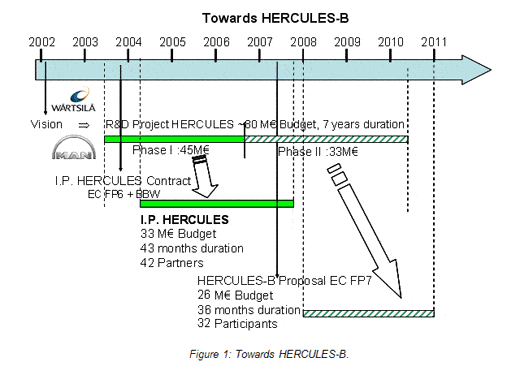
HERCULES C as the program will now be known is the third part or phase of the project that was initially started in the year 2004. The name of the program is an abbreviation for High Efficiency R & D on Combustion with Ultra Low Emissions for Ships. The details and the highlights about the project can be explained as follows:
- The HERCULES program has been sponsored and supported by the European Union and the government of Switzerland. Additionally there are a group of 43 members who are guided by two of the largest names in engine manufacturers – Man Diesel and Turbo and Wartsila Corporation
- In the years since the project’s planning and development around 79 million Euros have been spent. The final run of the project proposed from 2012 to 2015 is expected to have a budget of around 19 million Euros
- The three parts or phases of the HERCULES program are named as A, B and C. C being the planned HERCULES program for the coming three years between 2012 and 2015
- The HERCULES project mainly deals with better and increased efficiency needs for a marine engine. This also includes aspects about a marked reduction in the pollutant and emissions by designing engines with better piston rings. This is mainly in relation to tankers and their engines which have a higher rate of emissions in the marine environment
- In the three different HERCULES programs, although the core objective of the project was maintained, other different objectives were set and successfully achieved. One of the main objectives that was achieved was a substantial reduction in the fumes of Carbon Dioxide gas emitted in the oceanic waters with the help of better marine pistons and liners of cylinders
- In order to ensure that the program continuously achieve its desired success, constant technological developments have also been made. One such major development is the introduction of better cylinder liners, marine pistons and a gadget known as the Tribometer
- The tribometer is used to determine the amount of loss that is caused because of rubbing (friction) in the marine engine. With the help of this device, the level of friction is gauged and then using suitable materials, it is tried to reduce this problem-caused in the piston rings
- In its own way, HERCULES C is quite detailed in its objectives. While the previous two editions of HERCULES merely talked about reducing the level of fumes and pollutants, HERCULES C talks about a specific reduction rate. It plans to control the rate of pollutants and fumes to an almost nil quantity. This will ensure a greater deal of reliability on the program
The HERCULES program was initially developed in 2002. The research facilities were available only from 2004 onwards. In the eight years of its existence, the program has achieved quite a lot of appreciation and fame from all over the world. The effectiveness in the carrying out of its objectives along with the admiration is the factor that makes these programs a resounding success.
You may also like to read-The World Ocean Space Center Concept, Norway
Do you have info to share with us ? Suggest a correction
About Author
Marine Insight News Network is a premier source for up-to-date, comprehensive, and insightful coverage of the maritime industry. Dedicated to offering the latest news, trends, and analyses in shipping, marine technology, regulations, and global maritime affairs, Marine Insight News Network prides itself on delivering accurate, engaging, and relevant information.

About Author
Marine Insight News Network is a premier source for up-to-date, comprehensive, and insightful coverage of the maritime industry. Dedicated to offering the latest news, trends, and analyses in shipping, marine technology, regulations, and global maritime affairs, Marine Insight News Network prides itself on delivering accurate, engaging, and relevant information.

Subscribe To Our Newsletters
By subscribing, you agree to our Privacy Policy and may receive occasional deal communications; you can unsubscribe anytime.