


Real Life Accident: Towing Vessel Becomes The Towed
A multi-purpose cargo ship was making way in a busy TSS at about 15 knots at night and with a sole OOW on the bridge. The vessel was gaining on a tug towing an un-manned crane barge about 6 nm ahead. The tug and tow were proceeding at 6 knots and keeping to the northern edge of the traffic lane to enable other vessels to pass down its port side. The length of the towline was 250m.
When the cargo ship was almost at the level of the tow, the OOW adjusted the autopilot to port in order to overtake the tug on its port side. Seconds later, the vessel collided with un-manned crane barge; then continued to pass between the crane barge and the tug, catching on the towline on the way through. The OOW on the cargo ship quickly reduced the ahead pitch on the CPP but his vessel continued to overtake the tug.
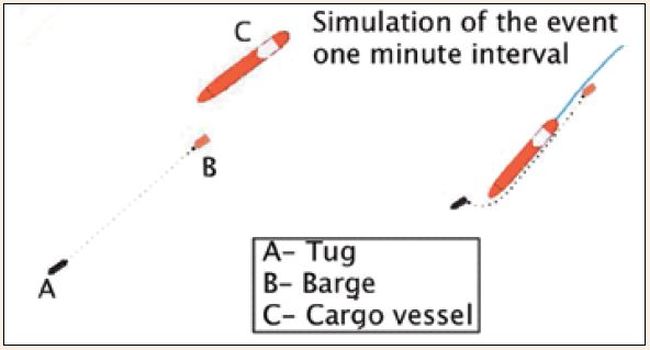
On the tug, the lead of the towline moved from astern to ahead, which pulled the tug through 180° and now saw the tug being towed stern-first by the cargo ship. The tug’s OOW immediately took the main engine out of gear and shouted down to the accommodation to warn the rest of the tug’s crew of the situation. Seconds later, the bitter end of the towline broke free from the towing drum; the tug stopped in the water with the un-manned barge off its starboard side.
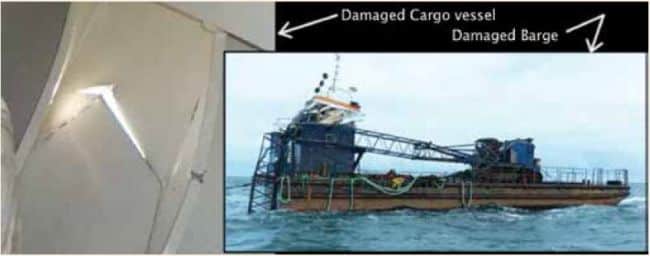
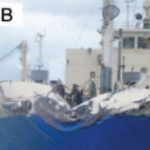
The barge’s wheelhouse had been set forward in the collision and crushed. The jib of its crane was buckled, guardrails bent, the tow’s hydraulic winch motor seriously damaged and several hydraulic connections ruptured. The cargo vessel suffered a gash in the forecastle. Some of the analysis and findings of the official report, as edited, are:
- For nearly 55 minutes before the collision, the radar targets associated with the tug and barge were clearly visible on the X-band radar of the cargo vessel. Additionally, the aft lights on the tow would have been visible from the cargo vessel for at least 20 minutes before the collision. The OOW had ample time to detect, assess and take avoiding action.
- The OOW had not been keeping a proper lookout and had only seen the tug just before he altered to port; he failed to see the un-manned barge at all.
- It is almost certain, as deducted from the sequence of events, that the cargo vessel’s OOW was relying solely on AIS information as shown on the ECDIS; but the tug and barge were not transmitting AIS information.
- The radar targets directly ahead and closing should have prompted the OOW to look out of the window and attempt to correlate the targets with visual information. As he took neither of these actions, and the targets were on the radar for almost one hour, it is likely that the OOW was not monitoring this instrument at all.
- The level of arousal of the cargo vessel’s OOW was low. Consequently, he was not proactive in maintaining his situational awareness or reactive to changing circumstances. This is supported by his failure to use radar or ARPA and to keep an effective visual lookout.
- It is impossible to determine whether a lookout’s presence on the bridge would have assisted the OOW in making a more accurate assessment before altering towards the barge. However, it would have increased the probability of the tow as well as the tug being seen. A lookout’s presence would also have probably helped keep the OOW alert.
Lessons learned
For collision avoidance, a balance needs to be struck between overreliance and effective use of AIS. In this case, the OOW’s apparent exclusive use of AIS information displayed on ECDIS indicates that he was not aware that many vessels, such as small fishing vessels, leisure craft, warships and vessels under 300gt, might not be displayed.
Reference: nautinst.org
Do you have info to share with us ? Suggest a correction

- Real Life Incident: Vessel Collision in Good Visibility

- Real Life Incident: Severe Injury To Deck Crew While Leaving Berth
- Real Life Incident: Departure Damage in Very Restricted Waterway
- Real Life Incident: Low Situational Awareness Has High Impact Consequence
- Real Life Incident: Fouled Anchor in a Designated Anchorage
- Real Life Incident: Fire On Barge Carrying Scrap Metal Causes $7 Million Worth Of Damage
Latest Case studies Articles You Would Like:
Subscribe To Our Newsletters
By subscribing, you agree to our Privacy Policy and may receive occasional deal communications; you can unsubscribe anytime.